Tribute – to Peter W. Stine

What won’t Stine say?

-The chicken, though adequately cooked, is sadly under-seasoned. Is there any lasagna, instead? I don’t sanction miniature corncobs.
-Not a bad speech, but let’s try to lose the accent, Mr. Mandela.
-In the land of the blind, the one-eyed man is king, right, Mr. Bocelli?
-Speak up, Mr. Hawking!—Carve your words and spit them out, like me when I shout this command!
-Hats off in the classroom, your Holiness.
-Mr. Devito, stand and deliver! Stand and—oh… Well, then: stand on a chair.
-The short hair doesn’t really favor you, Ms. Degenerous. Something softer, more feminine, perhaps.
-I would have thought you could have turned out a larger audience for our turtleneck reading of Murder in the Cathedral here at the First Baptist Church of Harpswell, Maine.

Something like that last one most likely got said on a Princemere Readers trip into the depths of the Bert-and-I State.

When won’t Stine begin a prayer on just such a trip?

Me: Hi, I’m Mark Stevick from Lancaster—

Stine: FOR THESE GIFTS, AND ALL THY MUNIFICENCE—for these seven residents of the hamlet of Harpswell, Maine, who will host and feed our twelve Princemere Readers—and their servant leader in a separate home because sharing a bed is unseemly in my considerable book… Lord, we thank you—♫ PRAISE GOD FROM—am I the only one spontaneously pray-singing?—♫ BLESSINGS FLOW—next song-prayer: ♫ THE LORD IS MY LIFE, AND—I can’t hear the women—♫ SALVATION!—have you got any more of those cupcakes, I’m a diabetic, but I could use cupcakes, diabetes, lots of jimmies, find my insulin bag, with frosting, if you’d be so kind… No? We’re out of diabetes-cakes? More’s the pity. That’s an expression that means “too bad.” You lobstermen don’t “readie muchie” do you? It’s all right—that’s why we’ve come to your small wooden church with our 3-hour rendition of The Scarlet Pimpernel. No need to feel embarrassed. There was a time in my life when I couldn’t read—AUSTIN?—are we saving some crabcakes for others? Fine.

[continuing] Breakfast tomorrow at half five—that’s 5:30 for you “Mainuhs”—and I know you’re already up then, trimming the mizzenmast, as I myself also constantly am—for the Men’s Matins Meal, or the Clerical Collar Choir practice—♫ WHOM THEN SHALL I FEAR?—or Racquetball for the Recovering—mm?—what’s that? No: I don’t drink coffee, especially not in Harpswell, Maine, ho-ho! I’ll have some tea if it’s English Breakfast, with milk first, not cream, otherwise just sea water in a small conch, I’m not hard to please. No, it’s “conk” actually, not “conch”—thank you very much, you’ve been malapropping it for centuries. If it’s worth correcting, it’s worth correcting loudly. Why compound ignorance with inaudibility?

__

Here at this retirement dinner, I hear you asking: How many such Stineian sayings have occurred on similar Princemere trips? 525 thousand 600 vignettes—no; let me do some accounting: since 1976 when PWS founded the Princemere Readers, two dozen productions have been uttered by a hundred-and-a-half voices for an audience in toto pushing 20k—in nearly half our states (22), and eight countries—thrice in England, (nearly) twice in Kenya, plus Korea, the Philippines, China and Japan.

Begun with a $500 budget, which had increased to $900 when all was read and done in 1999, Princemere was a blue chip investment, certainly. With a few hats and a good script, the Princemeres could perform in slippy black stockingfeet anywhere; and the scene, in the audience’s mind, could look like the Mississippi, or Hell, or Hester’s scaffold in the Puritan marketplace. And because Stine & Co had brought these settings & stories to their front stoops, a goodly number of high school seniors signed on for a Wenham address—and then paid their 6 or 12 or 21 thousand dollars a year for four-or-more years to its only-and-frugal college.

Princemere paid dividends for the Troupe, too. We were, most of us, sow’s ears, being measured and stretched against great literature: the hypotaxis of Hawthorne, and the figures of C.S. Lewis, the phonemes of Dylan Thomas, and Mark Twain’s metallic twang. We were buffeted by the texts, and by the tyrant director, too. What did he teach us but how to mark with our voice and breath, as he did, every flick of punctuation, every emotive vowel, every, every minute?

And, watching him, we learned, too, in talk-backs after the shows, that one may engage an entire room with bluster and finesse, teasing its members into a different kind of play, a tautened alertness, a finely suspended joy. He was at his best, burned cleanest, I think, in those give-and-take afterglows.

And he, he himself, the Stine carved the roast beast—no, he himself adapted all but one of those two dozen productions. Is it too much to say that those 23 publications (for the first public performance of a script is, in the writs of copyright law, a publication)—too much to say that they mattered more to kingdom and college than the several squat volumes on minor Victorian poets that might have borne his name on their infrequently-handled spines? It’s not too much to say that. (Though it was wordy, I lost my grip on the sentence.) Those 300 productions, 300 play-full, literary interludes, were his scholarship, and his reasonable service.

In 1979, Peter was given the Faculty Award by the student body for, among other things, his work with Princemere. In 1999, after missing two consecutive spring tours with foot sores and sickness, he retired from his adapting-of-lit and his troupe-of-readers. I know he would love for the shows to go on; and he had hoped that I could take up the van keys, but, alas, I couldn’t manage it all; maybe if I’d been married, with 4 kids and a pastorate to boot, I’d have had the time.

How valuable, for me, Patrick Gray, Carol Smith Austin and her man Philip, for Dawn Jenks Sarrouf, and Mark Frederick and Jennifer Hevelone Harper to have started out with Princemere; a troupe founded to “make great literature the handmaiden of the gospel of Jesus Christ.” Thanks to Stine I feel like I wrote The Great Divorce and The Scarlet Letter—books I quote often, and impressively, in my classes. Which returns me to my theme. What won’t Stine say. With the slightest of provokings, Stine will deliver a brief, hortatory essay on the value of such literature—and of the amiable word, the vigorous sentence, the paragraph “in the trim.” What he says will be imageful, figurative; it will sound like he’s wholly quoting when, in fact, he isn’t, though he will sample from Heaney or Churchill or Achebe to fine effect. It will be vintage Stine, and it will tingle you under the scalp to hear it, so that you’ll think, If only I could say that the next time I’m called on. As if.

What else will Stine say? Given the merest flash of an opening he will remonstrate with us not to abandon the teaching of public speaking at Gordon. “I speak for the trees, my wooden pupils, for the trees have no tongues.” And O, he is agonizingly right. Should you ever require penance, yours shall be to attend a senior breakfast and hear near-grads speaking cudgels when blades are required.

And this else will Stine say: “Here’s $150 for your Chemistry text; here’s $200 for the student emergency fund; here’s $500 to help get Anne aboard the London theatre trip—I know she can’t afford it, and I have some money from Betsy; but I don’t want anyone to know”—to which one says, “OK. No one will know.” Until your retirement dinner.

All those things will Stine say, along with lots of lively expressions that one hears, as a freshman from Lancaster, PA, for the first time, attaching them foreverafter to their ironic and bearded speaker: as it were; not to say; so to speak; memento mori; carpe diem; tempis fugit; carry coals to Newcastle; set the Thames alight; versatility is the hallmark of genius; fast nickels are better than slow dimes; non illigitimi carborundum; I’m not the bastard I seem to be; WELCOME TO COLLEGE. And that last bellowed phrase signaled welcome to new corners of poets, playwrights, novelists from the world’s wide four; and welcome to nutritious sites of historic and literary significance, narrated from Stineian memory; and to his home, and table, there to relish the easy, expert hospitality of his wife and family. And in my case, to England for the first time. Welcome to Dover, Mr. Stevick. I’ve got some things to show you.

At such a time as this, one wonders where to turn for language to help commemorate and reckon with his retirement. One tries to imagine a Gordon without him, and one remembers his important directives: Stevick, go to grad school; get your language requirement done; try radio; teach my oral interp class; apply for the position here; marry her, don’t wait too long; don’t wait too long—children are a blessing. These, too, Stine will say. How to gather the fruit of all that into words at once true and lovely? To quote usefully, “language staggers here”—or stumbles: at least mine does. Plus I’m afraid I’ll blub or do something ridiculous—

—because this spring I find myself toggling between “Stop all the clocks—Mark Stevick, are you grieving over Peter Stine soon leaving?” and what that means for us, for me in my 44th year to heaven

—toggling between that and lines by Wordsworth, unveiled by Stine in his class:

Though nothing can bring back the hour
Of splendor in the grass, of glory in the flower,
We will grieve not, rather find
Strength in what remains behind;
In the primal sympathy
Which having been must ever be;
In the soothing thoughts that spring
Out of human suffering;
In the faith that looks through death,
In years that bring the philosophic mind.

Perhaps Peter is finding Wordsworth was right. Through God’s grace and Sue’s kidney, I trust he’ll continue to find strength in and among his loves: family, friends and students; reading, writing, performing (from these may there be no severing)—and, next summer, traveling back to England to lead a 10-day literary excursion. The aged eagle’s wings have plenty of spread left in them.

And though much is taken, much abides at Gordon after Stine. Innumerables. For starters, two essential courses in the English department, Nobel Prize winners and African Literature; a theatre major and a black box theatre with a plaque bearing his name; and most notably, row upon row of alumni, I among them, whose lives have borne out another of his sayings—that with a liberal arts degree, especially in English, you can think and write and speak well, so you can do anything.

Some would say, about a legacy like that, “Well done, good and faithful servant.”

What would Peter Stine say about it?
“Not bad.”

Here’s to my professor, colleague and friend, Peter W. Stine.

-Delivered at Peter Stine’s retirement dinner in 2008. He passed away August 5, 2011. We carry stones, and pile them on his.


 

Toast – to Paul Borgman

I see him across the quad. His walk, like the silhouettes of certain birds, is distinct: alert, athletic, mit backpack, a posture and gait suited for distance, for lapping the miles, the texts. It is the walk of Thoreau, or maybe a tennis player, which, avidly, he was.

And he’s tending my way. What will this mean? I wonder because my friend Paul Borgman is liable to say anything, to speak truths I’d be too timid to utter.

—e.g: “Waiter, you’ve totally used the wrong vermouth in these martinis. Can I see the bottle? …No olive for me, thanks; I’ve brought my own sprig of basil.”

—and: “Just before we cast our final vote, this CORE curriculum is, to my way of thinking, totally wrongheaded. I’ve brought my own CORE…”

And, now, suddenly, this truth-teller is before me.

PB: Stevick! You young scoundrel.
ME: Hi, Dr. Borg—Paul. (old student habit)
PB: Stevick, when are you and that Kristi Wacome going to start having kids?
ME: Oh, ah ha ha ha…
PB: Don’t wait too long; Abraham waited too long, almost!
ME: Yeah, that’s—kind of true… What are you eating?
PB: Well, I was juicing for years, but these are locusts.
ME: Locusts?!—Oh, ah ha ha ha ha… Are they really?
PB: Absolutely, crunchy wings and all. Have one.
ME: Paul, are you a prophet?
PB: Nowwww, come on… Me, a prophet?
ME: But, Paul, the locusts, the sandals by Birkenstock, the fairly unusual camel-skin jacket, the hair shirt with hints of pastel—who are you preparing the way for?
PB: WHO, INDEED! Oh, Stevick, that’s good!
ME: It is?
PB: Yeah, Graeme, did you hear this?
GRAEME BIRD: Hi, Paul, Hi, Mark—you guys eating locusts?

At this point I slip away blissfully into the night, even though it’s noon.


Who is this locust eater, this sandal-wearer, this truth-telling, tennis-talker?

He is a fellow one meets in 1983 when one is 19 years old. He is teaching literature—of a pre-Renaissance, European flavor. He stands at the foot of MacDonald 109, looking like a certain engraving of Walt Whitman, loafing in cotton shirt and a hat—and he is roughly the same build, too, with the same manly beard, the same soulful eyes, the same famous hands. Famous, in this case, in how they shape themselves toward an argument—and around a text. Handily, sure-footedly, though the room takes on the pitch-&-yaw of Odysseus’s boat, this man bravely conveys us through passages of prose and poetry—

“Bravely” because (now hear me) in these sessions, with Homer or Moses or Faulkner, he does not turn away from what is difficult or distressing in the work—nor even from what is dangerous. He goes toward it. And asks that his charges do the same. Let us be accountable, he says, to the text, and one-to-another. Is there trouble somewhere? There we must attend. Except thou bless me, I will not let thee go, he says. It IS hard: How else can literature be adequate to our lives?

When we were young,
     the petal of the rose it was that stung.
Now we crave
     the sweet of bitter bark and burning clove.


So, what do we finally learn about this coy conveyor, this captain courageous?

A friend of mine, former student of Paul’s, recently said “Borgman was the ideal teacher; he made me want to try to teach like that.” So now he does try.

You know what else he said? “Paul was awesomely welcoming in his office. I loved going up there and talking books and ideas with him.” To which I replied, ditto. 

Further: who has not heard Paul say, “What a life! To get paid to teach what I love—to students who I love to teach! And that’s a chiasmus, Robert Alter!”

What is more infectious than this? Who is more effective, more astonishing, in landscaping a terrain so that students can walk themselves into a revelation? No one I know of.

Several times I have gone into a room full of people blandly interested in literature, mildly informed about this-or-that book—and felt that room absolutely arcing with expectancy because Paul Borgman was about to engage it.

Our man stepped to the front. With only his voice and his bearing, he began, warmed to his subject, pressed a few students into service, picked up steam; extolled, confessed, shouted, lobbed & volleyed—and then brooked a dissent from some brazen smarty.

SMARTY: BUT blah blah blah [*your view is endearingly wrong, here’s a revision*].
PB: Good, but where do you get that?
SMARTY: From blah blah, so that means blah [*total opposite of what you think*].
PB: You may be right, that’s [*from memory*] verse 37, so can you read that out to us?
SMARTY: Sure, ‘Blah blah came to pass, that blah-blah-blah blahbetty blah.’
PB: The end again?
SMARTY: ‘Blahbetty blah.’
PB: [waits]
SMARTY: Ohhh.

[audience feels amazement and respect]


Friends, Borgmans, sidemen, I have not the skill nor the learning to do justice to that scene. I will say it was like watching a prestidigitation, or a minor miracle, maybe like Nathan getting King David to incriminate himself—without the gold throne and the finger pointing. And the result was a little detonation of insight and delight that spread out and is still rippling even to this very moment.

One of my colleagues says, “Paul is, hands down, the best teacher-in-the-classroom I’ve ever seen.” Today an alum said, “Of all my teachers, perhaps all the people I’ve ever met, Paul is the one who most genuinely believes that literature not only can but should alter your life. And that we read because our lives depend on it.”

“Words draw him,” says another colleague. “English draws him to uncover the overcharged empty space of the human soul. Words are what he has.”

Words are what he has.


Which brings me to words I don’t have. Words I have not been able to muster about Paul’s willingness to look into the darkness. I’ve wanted to reflect and speak truly on this vital aspect of my colleague—

     a man who has been acquainted with the night,
          and with a certain slant of light—
          with heavenly hurt
     that wakes the heart to the darkness and into the sadness of joy.

But I can’t manage it this time around.

Instead, I’ll finish with these words. Writer. Speaker. Thinker. Model. Mentor. Raconteur. Provocateur. Defender. Advocate. Confidante. Supplicant. Communicant. Colleague. Friend. Prophet and Professor—

Paul Borgman, who, for 34 years, has climbed into and out of his corner office, like Ahab, or Father Mapple, leaving the rope ladder down for us.

For English majors, the evening sight of his high lamp in Frost Hall has meant he’s been busy—leading youngen folk on this pilgrimage, helming our trim ship toward landfall, toward understanding (through humility and zeal and faithful attention)—toward truths that are dear because dearly-bought.

I stand here, unfit representative for hundreds, nay, thousands of his students whose voices speaking together their tributes would make, indeed, a noisy throng, rising from hither and yon, from hallways, headquarters, cooperative farms, council chambers—and from the many households where the Word is welcomed to lead and to interrogate us.

It is the Word that Paul has served,

     the Word written and read,

          eternal and begotten.

On this day we are emboldened by his service, we are keen to extend his legacy, we are grateful to celebrate all these things, and, yes, we are crushed to see him go.

-Delivered at Paul’s retirement party in Phillips Music Hall (with Bert Seager and The Why) in December of 2014. Paul and Marsha are living it up in Florida this winter while Paul keeps writing books like David, Saul, and Godwhich we all worked on…

Toast for Norm & Jean

I first met Norm Jones in 1985 when I was two years old.
Could I have the PowerPoint, please?—thanks.

As you can see, he was heavily bearded with a thick—oh, no PowerPoint? Well, here he is, use him as a visual aid—he was heavily bearded, with a thick black beard.

At that time he was directing a Gordon production of “Mornings at Seven Old People Played by Kids in Heavy Makeup”—for which he single-handedly built a set that was the home of Marvin Wilson during the entire run.
Exaggerating.
He used two hands—please…

“Marv” is an “OT” “prof” who thought the theatre was a “lecture hall”—and who enjoyed sweeping up Norm’s sawdust before class. “He Ne Ma Tov…”

Anyway, what really counts is that Norm had a full beard in 2nd grade, and a full moustache in 3rd —as saints of old and Norm himself have often told.
Not bragging exactly…

In the first play we worked on together, a three-hander, he played a drunk criminal but who hugged boys. What a stretch.
At the end of the play, Norm’s character staggered in and died onstage. [pause]
So, here’s to you, Norm+Jean!…

Kidding. It was a daunting death scene to rehearse. During one run-thru, when we got to that scene, it was just too much… So as he said his lines, Norm began taking masking tape—and putting it on his face.

Here’s how it went:
Norm: “What happened?” *puts tape on face* “I hear women crying.” *tape* “Everyone’s tiptoeing around.” *tape*

And so my buddy Philip and I grabbed rolls (the set was built completely of masking tape) —and we began:

One of Us: “Pop, Sonny’s dead.” *tape*

Norm: [exhale] “Wh*en?”

One of Us: “This morning.” *tape* “Tataglia got him at the toll booth.”*tape*

All through the heartrending scene we were *donning* masking tape masks.

Norm: *tape* “I want you to use all your power, and all your skill…”*tape*

And by the time Norm died he had a fantastically grotesque Death Mask, so complete that he could barely talk.

Norm (with real difficulty): “I know a dead-end kid*tape* …when I see one.” *ta…* [dead]

One of Us: “Now cracks a noble heart.” *tape* —ostensibly weeping, but only just, JUST managing not to shriek into laughter.

Which turned a run-of-the-mill-thru into a gem, to carry for as long as we have pockets, with a luminescence to navigate by.

And that’s a thing we love about Norm, his savoring of things and meals and moments—and not them only, but also the qualities of people, and their quirks, and their little excellences.

Here I speak for many of Norm’s students and friends who have found their love of songs or words or play bolstered by his own, and who found his relishing of their strengths winsome and irresistible. Many of us have taken courage from his example and his encouraging us, and have dared into careers in the poorly-paying arts.

“Savoring” is another word for “loving”—and today we all savor the fact that he’s met a love to answer and equal his own. Jean, we needn’t have traveled with you to London and Edinburgh to know that you, too, are one who pauses to appreciate a shawl on a shoulder, or a certain light on a spoon or castle spire: your paintings show us, for one.

Norm loves that about you; you are his heart’s delight, his pearl of infinite price, with a luminescence to navigate by.

-Here’s to Norm and Jean, nine years wed this month (January, 2016).

Tribute – Mamas Don’t Let Your Babies Grow Up to Be Kinas (for Kina Mallard)

Mamas Don’t Let Your Babies Grow Up to Be Kinas

-to the Willie & Waylen / Ed Bruce tune

Mamas don’t let your babies grow up to be Kinas,
Don’t let ‘em run meetings or searches too much,
Let ‘em be milkmaids and barmaids and such.
Mamas don’t let your babies grow up to be Kinas,
They’ll never set still, no they always will roam,
Even from somewhere they love.

v1.
Kinas are easy to love but they’re harder to keep,
They’re sought for their skill at administering cattle and sheep.
They polish their titles and cinch up their Bibles
     and round their department herds in,
But when the weather turns chill and the dollars blow south,
Kinas are gone with the wind.

chorus
Mamas don’t let your babies grow up to be Kinas,
Don’t let ‘em be leaders like Golda Meir,
Let ‘em be scholars like Brittany Spears.
Mamas don’t let your babies grow up to be Kinas,
They’ll never set still, no they always will roam,
Even from somewhere they love.

v2.
Kinas like Tennessee waltzes and Kentucky moonshine,
Mint juleps and tulips and cowlicks and Deputy Dawg;
Them that work with her can’t figure if she’s a
     Saint Joan or an Eva Peron,
‘Cause on one hand she cut faculty workshop by a day,
On the other she still makes you go.

chorus 2
Mamas don’t let your babies grow up to be Kinas,
Don’t let ‘em bark orders and talk back to Jud,
Let ‘em be shy and compliant as mud.
Mamas don’t let your babies grow up to be Kinas,
They’ll never set still, no they always will roam,
Even from somewhere they love.

v3.
Kinas are almost as able as Ladybird Johnson,
Kinas are nearly as knowing as Atticus Finch;
But under that southern demeanor resides a
     tactician like Robert E. Lee,
And when she sidles up to you with a shucks and a smile,
You get committeed again.

key change—half step

v4.
Kinas are precious to find but they’re painful to lose,
There’s none better suited for telling the falses from trues;
And maybe you’ll say you won’t miss her and maybe
     you’ll practice forgetting her name;
But whenever someone gets their britches in a bunch about the
     busted budgets of Irv Levy—
Kina will be here that way.

final chorus
Mamas don’t let your babies grow up to be Kinas,
Don’t let ‘em run meetings or searches too much,
Let ‘em be ranch hands and farm hands and such.
Mamas don’t let your babies grow up to be Kinas,
They’ll never set still, no they always will roam—
Roam from a place where she’s loved.

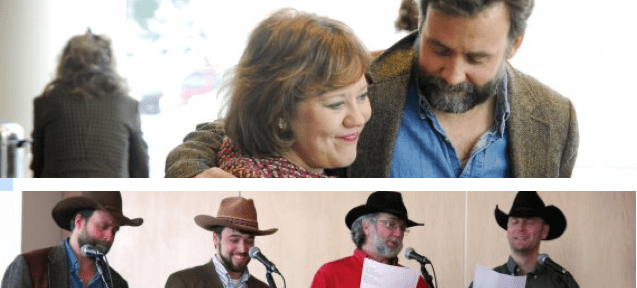
-sung by The Vocal Band at the completion of Kina‘s five-year tenure as Gordon’s associate provost. Kina was recently appointed president of Reinhart University. Congratulations. No barmaid, she.
Vocal band members are self, Oliver, Norm, Steve and, on the electric ivories, Graeme.

Tribute Poem – for ADF

Poem for Ann Ferguson

-upon her 50th year of teaching-

One score and a sesqui-score of years ago,
after battening books and folders into cartons,
she hitched the bumper up and made the slow
remove from Fenway northward into Arden.

Princemere was defunct: the railman had pitched
his polo-fielded mansion to the new U.N.—
little knowing that his ponds, his pine and birch
would be much better kept by Ferguson.

But nary an easel, nary a student center
in that lean hour—a barn door for a table;
but many the grace, and many the young apprentice
remarked what Ann could fashion in a stable.

E.g. should Oedipus Rex want staging there,
then she’ll direct it, and not some musical;
and should she count some wars worth waging there,
she’ll opt for beards, and champion The Crucible.

When fire sacked those vaguely equine quarters,
and all her files, and Grady’s, in one bright swoop,
she was unbowed: her actors without borders
rekindled as a traveling theatre troupe.

Look how when want or prospect called for action
over the years, she hastened to that place,
so that now the works of our Fine Arts Division
engender from her steadfast willingness.

Kudos to Ann—for teaching oil painting
without a decent studio or gallery,
for summoning students and going gallivanting
through myriad museums in France and Italy.

Kudos, I say, for gaggling them into Boston
for plays, then breaking curfew on return;
for standing up to such old-fashioned custom
as frames a room but leaves it unadorned.

Oh, a hundred-hundred tables she has laid
and set each hundred feasts before her guests,
and of all the finals her scholars have assayed,
it was the one at Ann’s they relished best.

Ever the vines that effloresce about her
are chastened into fruit beneath her steel,
and perennial from the riotous soil around her
are cuttings that bloom with her own daffodils.

See how when need or crisis called for tending,
over the years she harkened to that place:
to younger writers anxious for befriending,
or ailing kin—she modeled sacrifice.

Now at this jubilee it is most fitting
we further the remembrance of these things;
we toast you, Ann, your modesty permitting,
and wish you joy—we wish you, Ah! bright wings.

-with thanks to Ann for teaching, mentoring, and promoting me.

Corrupted Lyrics – To All The Grads I’ve Flunked Before

-after Willie Nelson & Julio Iglesias

Willie / N. Jones:
To all the grads I’ve flunked before
Who traveled in and out my door
I’m glad they came along
I dedicate this song
To all the grads I’ve flunked before

Julio / M. Stevick:
To all the grads I once assessed
And may I say I’ve failed the best
So much they didn’t know
Their GPAs were low
Yes, all the grads I’ve flunked before

-chorus-
The Gordon grads are always failing
Though they begged me for an A
Gordon grads continue failing
The failing grade is going to stay

-Willie/Jones:
To all the grads who skipped my class
Then said they simply had to pass
To them my ears were deaf
I handed them an F
To all the grads I’ve flunked before

-Julio/Stevick:
To all the grads who loved to cheat
Or begged me for an incomplete
Although they weren’t smart
They live within my heart
Oh, all the grads I’ve flunked before

-chorus-
The Gordon grads are always failing
Though they begged me for an A
Gordon grads continue failing
The failing grade is going to stay

BOTH: To all the grads we’ve flunked before
Willie/Jones: The freshman and the sophomore
BOTH: We marked their answers wrong
And dedicate this song
To all the grads we’ve flunked before

BOTH: To all the grads we’ve flunked before
Julio/Stevick: Poor junior and sad sen-i-or
BOTH: We know them all by heart
We’ll always be a part
Of all the grads we’ve flunked
Before

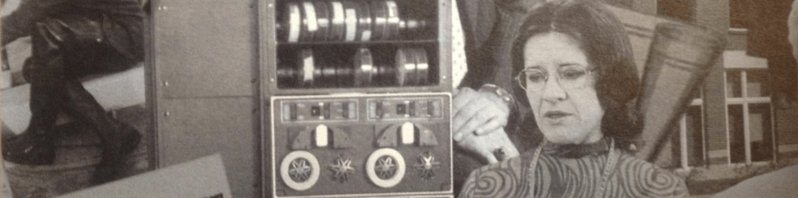
-sung in the manner of Willie and Julio at the Nodrog or the Black & Blue Review, with Graeme Bird on piano. Pic from The Nodrog. Jones wrote the better of these lyrics.

Corrupted Lyrics – Registrationville

Registrationville [to the tune “Margaritaville”]

Sign up for classes.
Slow as molasses;
Every semester I cry out to God;
No financial clearance,
No chapel appearance;
This whole registration—it smells like the quad.

Chorus
Wastin’ away again in Registrationville,
Searchin’ for my lost schedule for fall,
Some people claim that my advisor’s to blame—
But I know – it’s my own darn fault.

v2
Academic probation,
Grade point of a crustacean,
How it got there I haven’t a clue;
Pulled twenty all-nighters,
Eating pretzels from Snyders,
When I woke up, my classes were through.

Chorus

v3
I saw Carol Herrick,
I was so hysteric,
She told me the deadline had passed—I’m too late;
You’ll need a petition,
Instructor’s permission,
At this point I’ll have to attend Salem State.

Chorus

v4
I’m inside the chapel,
Drinkin’ my Snapple,
Kenny says my attendance was small;
Called Chaplain Carmer,
And here’s the alarmer—
Those trips to Starbucks didn’t count at all.

Chorus

v5
I tried Web advising,
I’m soon realizing,
I can’t even get Scottie Mail from my dorm.
Computer keeps crashing,
I feel like Mac-bashing,
A message from Jud on the screen says “No Porn.”

Chorus

v6
Filled with elation,
No chapel probation,
My advisor will really be thrilled;
I’m no belly-acher,
But here’s the heartbreaker,
The classes I wanted are already filled.

Chorus
Wastin’ away again in Registrationville,
Searchin’ for my lost schedule for fall,
Some people claim that my advisor’s to blame—
But I know –
It’s my own darn fault.

-The references are dated; the routines persist. In yore years, students were issued losable registration cards.
Sung at 255 Grapevine, or Nodrog, or Black & View Review (or all three) by writers Mark Frederick, Norm Jones, and self–and backed by Eric Convey on drums, Steve Crowe on sax, Little Taylor Jones on basket. Our “band” was known as Communication Breakdown.

The Fife & God’s Mouth – a Senior Breakfast Speech

The plaintive cry of the fife.
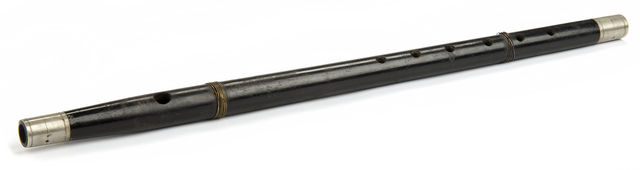
[fife—almost play]

In your mind pick a number from 1 to 4.

You chose 3.

Who picked 3—raise hand.

If you didn’t, pick 3 next time.

If you didn’t pick at all: [tsk tsk]
choose this day whom you will cooperate with…

The fife.
[—almost play]

Senior breakfast.
Breakfast?
Whose good idea was that?

“We’ve worked ourselves to pulp for 4 years, let’s kick back and celebrate—at breakfast.”
[fife—almost]

“Whew! What a fast! Anyone else been fasting? Let’s break, I’m starving…”
[fife—]

“To commemorate your 55 years of dedicated service, we honor you here at this farewell breakfast...”
[fife—]

“Dude, I proposed over a candelit breakfast…”
[quickfife—]
“Yah, he got right down on his knee in the middle of breakfast…”
[fife—]

[French] “Good morning, monsieur, madame, may I start you out with an appetizer—oh, that’s right, it’s breakfast.”
[fife—]

Breakfasts are for people who can’t stay awake in the evening… the other kind of seniors.
[fife—]

“LIVE FROM HOLLYWOOD, it’s the 87th annual Academy Awards—at BREAKFAST.”

There’s a reason they don’t do that.

Think of the stars & celebrities—at breakfast.

Samuel L. Jackson: “Mhmm! That is a tasty danish!”
Ian McKellen “Not just a poached egg, my good man.”
Nicholas Cage: “I don’t care! I don’t think we should be eating sausage!…”
[sorry, that was actually Keanu: “What do you mean ‘half & half’—which half?”]
Al Pacino: “Ok, ok, ok, muffins—gweat, we gotta eat muffins… Bwing ‘em.”
Bill Murray [cigarette]: “Are you planning on repeating this every year?”
John Lithgow: “I’ll have an omelet!—with a side of hash brown.”
Tom Brokaw: “That sounds lovely, I’ll have an omelet also, and a jelly roll.”
[I don’t know why Tom Brokaw’s here, how’d he get a ticket?]
Jack Nicholson: “Soft shell crab, por favor. [passes hand over forehead] And that’s probably not grapefruit juice.”
President Bush: “This whole thing: it was my idea, see? My menu. My scrambled eggs.”
Bill Clinton: “If it were up to me, my preference would be to do it as late as possible…”
Mark Sargent: “Moons over my hammy?”

See, dinner—dinner’s at the end of the day, and you’ve come to the end of college, but breakfast is at the awkward beginning of the …

Ohhh….

Ok, all right. Well, there are some things I want to say to you, Senior Breakfast Class. Now that you’re beginning—you better lose yourself in the music, the moment, you own it, you better never let it go; you only get one shot, do not miss your chance to blow; this opportunity comes once in a lifetime, yo.

That’s not quite what I mean, I have trouble finding the right words.
So I’m going to quote someone instead, let him speak for me. I bring you this passage from Steven, a text from earlier in Steven’s life and work—Steven Martin—and it’s one he set to music, too, so:

[fife—]
I don’t know how to play this thing.

OK, here it is, deep, deceptively simple admonishments for a time such as this:

Be courteous, kind and forgiving,
Be gentle and peaceful each day,
Be warm and human and grateful,
And have a good thing to say.

Be thoughtful and trustful and childlike,
Be witty and happy and wise,
Be honest and love all your neighbors,
Be obsequious, purple, and clairvoyant.

Be pompous, obese, and eat cactus,
Be dull, and boring, and omnipresent,
Criticize things you don’t know about,
Be oblong and have your knees removed.

Be tasteless, rude, and offensive,
Live in a swamp and be three dimensional,
Put a live chicken in your underwear,
Get all excited and go to a yawning festival.

And to that I add:

Strive to be at least as tall as Jennifer Beatson,
Yearn to dress as well or better than Ron Kay,
Endeavor to be half as articulate as Dick Perard,
Don’t be worried until your laugh gets louder than Dorothy Boorse.

If you need a kidney you know who to go to, Sue Hakes still has one,
Try to be as passionate about something as Irv is about Johnny Cash,
Know that it’s ok not to be as smart as Elaine Phillips or Suzanne, no relation,
Realize that wearing Birkenstocks may make your voice one crying in the wilderness like Paul Borgman.

You can always apply for a job with Public Safety,
This song’s not as good now as it was and meaningful,
Just you try to be as cheerful as Pat the lunch lady is,
Let us all seek to live as long and whistle half as well as Grady Spires.

Music goes with Message, you see.
The few other things I care to say, with or without music, are also pilfered material.

One is: He who began a good work in you will carry it on to completion until the day of Christ Jesus.

And if Paul’s not your thing at the moment, this: For I know the plans I have for you, saith the Lord, plans to prosper you and not to harm you, plans to give you a hope and a future.

And if prophets aren’t your bag right now, try: Why take ye thought for raiment? Consider the lilies of the field, how they grow; they toil not, neither do they spin: And yet I say unto you, That even Solomon in all his glory was not arrayed like one of these. Wherefore, if God so clothe the grass of the field, which to day is, and to morrow is cast into the fire, shall he not much more clothe you, O ye of little faith?

And if Jesus just ain’t all right with you at the moment, then I care to say, from myself:
Speak up, complain, argue, shout,
wrestle with the angel;
maybe she’ll wrench your thigh.
Be hot or cold: God shall keep you in God’s holy mouth.
And, as often as you can, put God in your mouth: go to communion.
I’ve been at that place, and at times all I could do was go to the Eucharist. Good.
Stay at the table.

We believe: help thou our unbelief.
Suffer us not to be separated
And let our cry come unto Thee.

At all times and at some times especially you will be Exiles.
We began this year with Dr. Daniel Johnson, acknowledging that.
Remember?—

By the waters, the waters of Babylon
We lay down and wept, and wept for thee, Zion
We remember, we remember, we remember thee, Zion.

Remember these dear hearts, Dear Heart, now that You’ve come into Your kingdom—
is my breakfast prayer for you.

-Still is.

Why Orvieto?

Orvieto. A hilltop town between Rome and Florence, but so what?—good for you, Orvieto, enjoy your exotic hilltop self, but why would I go there? I already did the pulling-up-stakes thing, and am now settled in the dorm where God has shown me. Besides, they don’t speak English there, they mangia in Italiano cuesto. (Which actually means “they eat in Italian this.”)

Hey, I, Mark Wacome Stevick, teacher of poetry-writing in Orvieto, get you. Example?

First time I’m there, my feet are fondling the firm cobblestones when a shiny Norwegian couple swings up and hits me with, “Mi scusi, dov’è il duomo?”—(“Where’s the cathedral?”)—Ok, good—but I, because I only listened to the “Sing Your Way to Italian” CD twice, can’t really break bread with them—so what do I do but don my Apology Face and explain:

Non PARLI Italiano”—which I later realize means, “YOU don’t speak Italian.”

“I’m so sorry, you don’t speak Italian…”

So that’s why they went away snickering.

A funny story, and true.

But is it valuable?

* * *

M was a student from Messiah, a Mennonite. She wrote this poem about the crucifix that hung in the convent library where we had class. Here it is.

To the Crucifix

Jesus Christ I must confess
I’m staring at your chest again,
Your naked hairless body hung
Here on this wall again
Good God and don’t you know it’s
Got to be indecent.

High Christ I’ve cried so long for this pierced
Passion but popping up here
Now and again and forever
For Christ’s stake
An indecent eternity you bleed
One has only so much hair to
Bathe your feet in.

Christ I wonder if to relieve you
One took out one solid nail
That held your hand,
If your right arm dropped
Heavy across down the face
Of the sad glass clock
That fixes you,
The minute hand towards the
Half hour
Swung a circle that would
Move you once
So we could look away.


crucifix for blog 3


K went to Houghton College. Most afternoons at 5:00 she walked to a service at a convent where the nuns are cloistered and silent but for the singing and prayers of their services. Once she took me. She said the Amens right with the sisters, and afterward they smiled audibly at her through the bars in the chapel. She told me those services might be saving her faith.

W was a Gordon guy, and he was constantly arriving home noisy and happy after some dinner or service or concert with his friends the Lardanis and the other charismatic Catholics—people who were so salty, so irrepressibly incandescent that the new Bishop of the entire region invited them to hold services in his private chambers.

And a couple days before that semester ended, something took me to W’s room. He was in there among a heap of clothes and books and scraps of poems, crying fat tears. And he didn’t kick me out, and I said something like what you’d try to say then, and after a while he said, “In my life I’ve never felt such belonging.”

In his life.

M’s poem is one that I’m glad got written. It’s honest and surprising and maybe a little worrisome. Honest like the woman at the well: “That chump’s not my husband.” Surprising like the woman who said, “Yeah, but even the dogs get to eat the scraps that fall from the table.” M’s poem reminds me that God loves problem children like Jacob and David.

—and like M, K and W, who were learning a new faith language in Orvieto. Or maybe adding new words and sentences and silences to the language they already speak. How do you get to the place where you fall in Love—where the Amens are finally true and truly meant? For them it was by pulling up stakes again and wandering, not commuting like Americans, but wandering like foreigners—

into white rooms pinned with crucifixes,
into chapels of communicative nuns,
or into homes where, though you hardly speak Italian, the table is laid, and you’re made to understand: Mangia. Eat. Mangia!

Mangia.

-Delivered some years back in a Global Education convocation.

Essaying – on Learning from Corrie ten Boom

For symposium this year, my public story class put together a podcast on appearance & reality. (Some of you came and told stories.) We all wrote essays about moments in our lives that touched the theme at different angles.

I got thinking about how sometimes pretending or acting As If can be a way toward truth, a way into feeling it.

Sometimes you don’t feel like praying, or saying thanks, but you do those things anyway and end up feeling grateful. Sometimes you don’t feel like loving your spouse, but you do—and then you do. Sometimes you really don’t want to love your enemy, or pray for them, but when you bring them before the throne they become a person, not just a name–historied and complex as you are, with things you can try to forgive, the way you hope to forgive yourself.

Besides Peter jumping out of the boat acting as if he could walk on water, the best story of this kind that I know is Corrie Ten Boom’s.

She’d been a prisoner in Ravensbruck concentration camp. After the war she traveled the world speaking about God’s forgiveness. At one such event a man approached her whom she recognized as having been one of the cruelest guards in Ravensbruck.

He told her he’d become a Christian—and then he put out his hand and asked her to forgive him for the things he’d done as a guard.

She couldn’t do it. Here’s what she writes:

‘Help, Lord!’ I prayed silently. ‘I’ll lift my hand. I can do that much. You supply the feeling.’

And so woodenly, mechanically, I thrust my hand into the one stretched out to me. And as I did, an incredible thing took place. The current started in my shoulder, raced down my arm, sprang into our joined hands. And then this healing warmth seemed to flood my whole being, bringing tears to my eyes.

‘I forgive you, brother!’ I cried. ‘With all my heart!’


Here are three of your colleagues, Nate Youndt, Sarah Henkels and Katherine Allison, to read excerpts from their essays—to tell stories from their lives. In Nate’s, he tries something similar to what I’ve been saying, but ends up with more truth than he’s ready for. In Sarah’s, a cousin’s reality is almost too hard for a family to bear. And for Katherine, one chance encounter changes the whole kingdom forever after.

All these stories bear out what we know, which is that truth is better than semblance, even if it’s hard, and hard to get to.

Letter – Thanks for Prayers (last Christmas)

Dear Colleagues,

Many of you took note of the fact that I was in the ER on Friday [last year], ready for emergency surgery. Just before the surgeon got out his strop, he realized my dangerous hernia actually wasn’t so, and that I could safely delay the business until after classes and finals are done. Praises.

Many of you–maybe every single person at Gordon, who knows?–prayed for me Friday, and perhaps God, who is outside time, and whose Son interprets our words and wordless groanings, credits those prayers where and even when they are most needed. Surely I was, I am, the beneficiary of those prayers. I feel I will continue to be. Thank you so much for them.

(I hope I’m not being heretical. I know I’m being grateful.)

I ask God to multiply those prayers of yours as Jesus did with loaves and fish, and to distribute them where they are needed, especially to people we love here at Gordon who need them–and to those of us who suffer any kind of trouble, who await diagnoses with shortened breath.

–and even to change their water to wine, those implorings to thankings, for gifts of life, like newbie Anders Hunt, whose birth I will always associate with my own unexpected, undeserved return to health.

Mark

-gratitude from December, 2014. Beverly Hospital gets my vote.

Toast – to the Princemere Readers, 1986-1987

Bad Eggs in Time

Another year has run its course,
We played Divorce and Letter;
Our attitudes have gotten worse—
Our acting little better.

We have comprised a motley crew,
As tart a group as any;
Of actors we have had a few,
Of loud directors many.

Our true director Philip begged
Rehearsals often tedious.
We learned that God would break our legs,
Then Mrs. Stine would feed us.

When Vince’s amorous shalom
Might leave us with a man short,
Our flirt was called back to ‘the home’
From his asylum transport.

If Hawthorne we improved a bit,
The Essex show surprised.
If Dr. Howard had seen it
He’d have been galvanized.

We’ve lived it out and found it so,
It’s more than just a rhyme:
With Princemere and with Stine you’ll grow
To like bad eggs in time.

Our lizards, then, have turned to love,
And we have wished to show
That hope none but the Readers of
The Stine can ever… really… truly… know.

April 16, 1987

-Over spring break, Stine and the Readers took The Scarlet Letter and The Great Divorce to CT, NJ, DC, MD, and PA. The performers were Carol Smith, Gregory Kithcart, Virginia Perniciaro, Philip Austin, Becky Trimble, Vince Morris, Maria Sgourakis, and Peter Wilfred Stine.

Toast – the 1992 ECA Drama Class

In accordance with tradition
And the laws of elocution
I have metered here and rhymed some ruminations—
About the goals that you’ve achieved
And all the little ways you’ve peeved
Me, so get ready for some grim illuminations.

As I faced the class last autumn
It seemed I was at the bottom
Of an overgrown and steep and stony trail;
And though I hiked with gut and gumption,
When we made the spring produmption
Mr. Kirby wore a business ponytail.

This year I laid heavý emphásis
That to keep the pick-ups fast is
How to stop a play from crawling like a tortoise;
And you tried hard, though I should mention
That when our crowd seemed taut with tension
They were really stiff as boards from rigor mortis.

This was only the beginning
For a group whose daily sinning
Took forgiveness to an exponent of seven;
Could God have known, when He decreed,
“You must absolve the absenteed,”
about the 50-hour workweek of Jay McKinnin?

We built Our Town in just ten weeks
And if we peopled it with geeks—
Still, on opening night I felt it in my stomach:
Not ‘cause the wedding vows were magic
Or the graveyard lines were tragic
But because the curtain call was highly comic.

Now I’m left with wishing-well,
Though if by now you cannot tell
What I mean to say, you haven’t paid attention:
He who began His work in you,
In which I’ve helped, will see it through
And bear you on until the great day of completion.

Congratulations,
Blessings and prayers,
And fond, fond regards,

Mr. Stevick

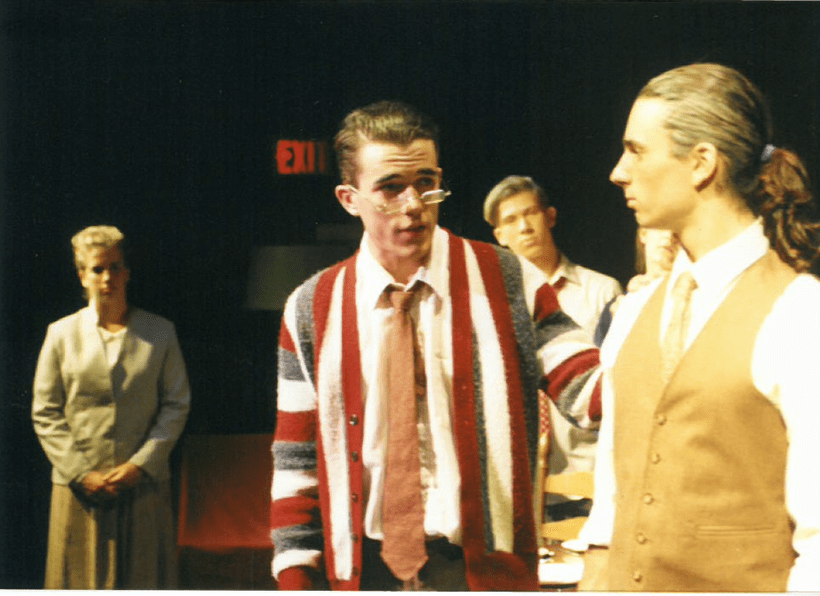
-pic: “You Can’t Take it With You,” with Becky Wooster, Tim Sidmore, Tim Larson, and Ben Adelman.