Tribute – NORM Man of Drama (for Norman Jones)

NORM MAN OF DRAMA the Spoofical – songs adapted by MWS from Man of La Mancha by Wasserman, Leigh & Darion

-a clip from the final song is here | a scratch version of all the songs is just below-

MARK: Let us begin by thanking the many of you who suggested songs to adapt for a roast & toast of our man Norm. We got a bunch of Jones songs: Tom Jones’ “It’s Not Unusual to be Loved by Anyone;” Billy Paul’s “Me and Mrs. Jones,” good one, obviously; George Jones’ “She Still Thinks I Care”; Norah Jones’ “Don’t Know Why [I didn’t come to his your show]”; Larry Norman‘s, “I Wish We’d All Been Ready” (everyone got trampled on the floor… epic line, perfect for the ending of Hamlet); and Jack Jones‘, “The Impossible Dream” (as if we’d do that one).

One of our STEM profs (you guess who, it was Craig) wrote lyrics to a Rush song, “Cinderella Man”—here they are…

Hey, Norman, man / directing in a can / hope they’ll understand / your new scenes.

How did we resist? Someone else thought we should hire James Taylor to sing some adapted lyrics for Norm (they share a birthday, March 12)—great idea. ♫ Whenever I see Norm’s smiling face, I have to smile myself, because I love Norm.

Somehow we turned away from all these great ideas, and maybe toward adapting a Broadway musical to Norm’s life. (Sure, that’s easy to do.) Some of those suggestions: Guys and Jones, Normoucel, Chica-jones, The Music NormMan, The Book of Norman, Normlight Express, A Little Norm Music, Joneseph and the Amazing Technicolor Normcoat, Normelot, Norma Mia, and, of course, Norman Jones Superstar. Tempting.

Actually, many of these could work—and I kinda feel like we want to sing a bit, do we? OK, let’s go for it. Here are some possibilities; ready?

from The King and Guide Jones: ♫ “Getting to know Norm, getting to know all about Norm, getting to like Norm, getting to hope Norm likes me”

from Normklahoma: ♫ “O what a beautiful Norming, O what a beautiful day, I’ve got a beautiful feelin’ – everything’s Norming my way”

from South Panormphic: ♫ “Some Norm-chanted evening, you may see a Joneser, you may see a Joneser across a crowded room”

from My Fair Jonesy: ♫ “I could have Jonesed all night, I could have Jonesed all night and still have Jonesed some more” [wish we hadn’t sung that]

from Normy Poppins: ♫ “Norm-Normany, Norm-Normany, Norm-Norm Norm-ee, Norm Jones is a lucky, much luckier than me”

and again, Normy Jonespins: ♫ “Just a Norm-ful of sugar helps the metaphor go down {repeat} in the most delightful way”

An embarrassment of riches here, paralyzed by the musical possibilities. Then we remembered: in ancient days, before he knew Into the Woods, Norm loved a musical: Man of La Mancha—so much, in fact, that when WE began working together in 1989, Norm named our b/w printer Don Quixote and our color laser printer Dulcinea. Those printers clinched it; bc of them, and because of Cervantes, I talk like a Spaniard now, somewhat ill-advisedly, sí:

We shall celebrate a man:
Come, enter into our reminiscence and see him: back then,
30, Houghton-faced, eyes that churn with the fear of unemployment;
He conceives an urgent proposal-and-cover-letter—
To become a direct-ant
and enter stage right the world of academia.
His name-to-be? Prof Theatre-Man-of-Drama!
__   

“I’m That Guy, Prof. Theatre” 

JACKIE MEERS: “Hire me now!” says his headshot, a clean-shaven face
And a skinny, all-acting CV;                            
Howard’s office is empty—could this man replace  
G. Lloyd and Kevin Lockerbie?

PREZ JUD: Hire that guy, Norm from Kingsley—
A master’s in drama!—
Saul Elkin said, “Where you been, bro?”
As a Youth Min. from Houghton                           
He’ll silence the doubters
Who think actors hail “from below”…

This one’s from cold Buffalo;
Eastward to Gordon he’ll go!

SIDEKICK: I’ll watch you,                                  
I’ll repatch you,
With canvas and plaster and lauan,
I’ll help build your worlds soundly:
I’m his sidekick—ex-student.

STEVE/NORM: At the foot of a lecture hall jutting from Winn,
Where the freshfolk are bored and core-classed,       
A miraculous windmill will soon start to spin                      
When “Mundane at Seven” gets cast…

NORM: I’m that guy, Prof. Theatre,    SIDEKICK: (I’ll watch you)
The Norman of Drama!                (And I’ll catch you with)
Lionel Bas-ney helped me emote.   (ladders and flats and el bracket)

From my mild Merritt Island         (I’ll help build)
I journeyed to Fancher,                 (Each world soundly)
Then quested to cold Buffalo…      (I’m his hire—ex-student)

BOTH: Weather’s so cold—tons of snow.
Warmward to Gordon—let’s go!
__                                                                                

MARK: “Warmward”? Temperature-wise, Gordon was the same as Buffalo in 1985. But the climate toward the arts needed to thaw a bit—and perhaps had just begun to, thanks to Dick Gross, the president who hired our man, and even more to Jud and Jan Carlberg—Jud who was dean of faculty, and who became prez in ’92; it was Jud who said Yes to a Department of Theatre (surely thanks to Jan). But when Norm arrived, theatre was still programa non grata and mostly viewed with doubt-&-fear by The Faithful. It appeared as “speech” or “speech and drama” in English programs (see Norm’s Hypernikon picture). And that’s the theatrical winter his new students, his discontents, were dressed for in 1985—not daring to hope for a glorious summer through this son of New York…

“Let Drama Reign”

ALL: Fool? Wise? Norm Jones-a! Norm Jones-a!
Be made fun of! Be made fun of!
He may, Norm Jones, be made fun of!

RACHEL: My school’s fine arts are fine but smothered,
We stage dramatic skits in Lane;
Spring breaks our players tour to southern
Concrete cities, ágain, agáin.

Our elders scorn imagination,
They view “pretending” with disdain,
Want “English oral interpretation”
To educate, not entertain.

ALL: So who’s this fool who speaks his love,
Love for the Stage—is this fool wise?—     
For whom catharsis is the plan                             
To incarnate the Mysteries…

If he could help our hearts discover     
Miraculous things in mundane, 
See the beleaguered muse and love her, 
Move Wenham Wood to Dunsinane.

ALL: Will this new charmer launch a school
Decades before Prof. Dumbledore?
And might he cast dramatic spells
Before he owns a wand of power?   

Could we all yearn, before it’s died out,
For what a child can ascertain?—
Truth’s a Great Hall and not a hideout;
Let drama reign. Give the fool rein!

ALL: Norm Jones-a!
__                                                                                

MARK: The fool did reign. Or he “made it rain.” Or he took the reins—did you know Norm knows horses?—thanks no doubt to his Uncle Max, he can fettle—he can shoe a horse if needed. An apt metaphor: Horses are all flicker and power, and danger and grace—like students, like actors, needing training, discipline, good shoes (maybe cothurni, those platform shoes worn by Greek tragedians). We students arrived like colts, dolts, idiots, really, our tales/our tails full of sound and fury and—till he got busy with hammer and hooflutz—signifying nothing.

“An Idea” (vid here)

STEVE-as-NORM: First, your scenes are too long,
And there’s nothing uniting the vast individual parts.

STUDENTS: What are we doing wrong?

STEVE-as-NORM: You’re committed, you’re loud, but there’s still
Something missing at heart:

An idea. An idea—
It’s your help and only hope, like Princess Leia…
One that guides each further choice—see Stanislavski:

ALL: The Idea…
STEVE-as-NORM: Your eureka. 

[discussion, agreement]

STEVE-as-NORM: Now in “Twelfth Night” you need…
STUDENTS: A location near water where everyone captures a spouse.

DAN: We were hoping that we’d
Somehow end with Malvolio stuck in a tiny outhouse…

STEVE-as-NORM: Dumb idea.
ALL: Bad idea.
DAN: I was thinking he’d be sick with emphysema.

STEVE-as-NORM: What if you would set the whole shebang in—
DAN: …Venice?
STEVE-as-NORM: Nice idea.
STUDENTS: Mama mia!
__                                                                                

MARK: Everything must support the idea of the play, said Peter Brook, whom we heard say more things like this at the National Theatre in London. London’s where we also saw three superlative productions of “Twelfth Night,”

(1) where Mark Rylance’s first line as Olivia, “Take away the fool,” got the biggest laugh in history of theatre,

(2) where Desmond Barrit as Malvolio came downstage to show his counterfeit letter all-the-way-to-us in the very last row of the Barbican theatre, and

(3) where David Bradley (Filch) as Sir Andrew Aguecheek – tell us, Norm. [Norm relates the story of a drunk Aguecheek staggering onstage and then staggering backward all the way out without ever speaking a word.]

We still call that one The Perfect Production, one against which all others are measured. Norm’s recent production of “Into the Woods” just measured up and earned that appellative. That show, and each of his shows require its 10,000 hours—of rehearsal, yes, and of memorization. Gotta learn your lines! You off book? I’m not off book, we’re supposed to be off book. Line. Line!

From “The name of this play is Our Town” to “You get a good rest, too,”—the question is always, how do you memorize all those lines?

“I’m Always Learning My Lines” (vid here)

JERICA: I’m always learning my lines.
ALL: I’m always running my lines,    
Whenever I am in his play
I’m always pounding my lines. 

JERICA: Once they asked me in OT
To quote Psalm 23;
I said, “Yea, I walk through anoint my head with my lines.”

JASON: When my friends invite me northward
To the slopes of Sunapee,
I can only say “My quandary
Is to ski or not to ski?

MALACHI: When my buddy says—
BRIAN JASON: “We’re failing, we should make a study group,”
MALACHI: I remind him firmly I am more
Afraid to fail The Troupe!

Et tu, Buddy?
No can study—
Anything but Norm’s all-consuming play…

ALL: I’m always mumbling my lines,
I’m always fumbling my lines.
I’m sometimes screaming and often dreaming my lines.

EMILY: I was by myself declaiming
(All my tricky lines to con),
When a Gopo cop approached me
And inquired what drug I’m on…

CHARLIE: At Chipotle with Sharona,
She was feeding me my cues, then she said,
HANNAH: “I think I love you,
And I hope you love me, too.”

CHARLIE: And that was fine.
But I said, “Line.”
That moment’s not the best one to call line…

ALL: We’re always learning our lines,
We’re always dropping our lines,
We can’t stop learning—we keep forgetting our lines.
__                                                                                

MARK: Though Charlie’s and Hannah’s characters there ran into a little discord, concord is the goal—to get a production’s many moving parts all moving in concord. Sometimes, too, marital concord follows, as with Ben and Sarah, Darcy and Tyrelle, Glenn and Maryellen (dump him), Dawn and John, Mark and Kristina. A miracle! Here’s our own hands against our hearts. Afterward, relationships are what we are left with, ones we’ve made with actors—designers, builders, dressers, managers, TDs, and, of course, audiences. And with Norm, himself.

As for the beautiful set… Well: we strut and fret our hour upon it, we bend it to our awe, then…we break it all to pieces. In the theatre, this ritual un-making is known as striking the set, and it’s a given.

“I Strike It” (brief vid here)

BIANCA: I strike it.
Also unspike it.  
You’ve got to move it on when he’s done;   
Don’t fight it.

They argue, “This could be my apartment;
I could sleep here ‘cause it’s cute and flame – retardant.”

Though we built it for Godot, 
They want to use it for Othello;
It’s a thing to replace with a good empty space,        
So I strike it.                  

What do you get out of it? “The Empty Space.” The?—oh, right. Also a speeding ticketJess Algard gets invited to sing…           

JESS: I make it.
He dreams, I make it.
I measure, order, frame and tech direct—
Then break it.

Erasing’s – part of being artistic;
And for me it’s not completely un-sadistic.

This set’s a monument to Change,        
A dreamscape to rearrange.        

JESS & BIANCA: Free the boards, free the screws,  
No more lines, no more cues,        
ALL: Now we bid them adieu, we can conjure anew   
When we strike it!
__     

MARK: That one’s so fun we almost did it twice. 
Each play always has its final curtain. Exit consumed by the bear of time.
But then: O, she’s warm. The ashes rise, the dry bones live. Yes, another opening of another show.

Wait, hang on—what other show? You’re doing—not that one—really? No no no no… And the admonitions come, the loving Concert of Concern and Complaint—exhorting us to choose the next season more carefully. (We really, truly do love Philippians 4)—and speaking for myself, I think Jesus was right to include the weeds, the trampling feet, and the grackles in the parable of the sower—

and there was some pretty divine dramaturgy in the tale of a man who was accosted by thieves, left bloody and for dead… before the redemptive part.

In this next number, the mistakings you’ll hear in the play titles may say more about the objectors than about the plays themselves or the Norm who chose them…                                                                          

“Why Does He Do the Plays He Does?”

GINNY:Why does he do the plays he does?
Why does he foist such things?—
Temptressed, Transfusions, and Our Donkey’s Good,  
Crooks-able, Crock Circle, Keep Out of Woods,       
Skin Off Our Teeth, A Midnight’s Summer Scream—
Oh, why does he show us these?                            
(What’s the air like—he breathes?)

DEBRAH: Why’s he assign the scripts he does?—
Read and direct such scripts?
Wrequus and Doll’s Louse and Sinner Faustus,
Inspector Claws and Steel Pneumonias,
Arsen-Sick, Bach-Cry, Gross Ménagerie—   
(He dóesn’t write them, does he?)  
Why can’t he do Annie?   

GINNY: Most of his shows
Get letters demanding they close,
DEBRAH: And noting the road on which our…
College goes…

DEBRAH: Why must we do the plays he loves?
Why must we say these things?
GINNY: Cameflop, Cozens and The Noise Next Door,
DEBRAH: Trovin and Marjan’s and Measure-Unsure,
BOTH: Since You Dislike It, Can’t Take It Why Me?
Appreciátion integrity!
Can’t someone help Norm, please?
__                                                                                

MARK: “What does he want from me?” is the last line of that song in the original musical. My early version was “What does he want for me?” Which isn’t funny, but it does point toward comedy, the Shakespearean kind, where students grasp hands with each other, and make peace with themselves and their pasts, and maybe for the first time can see a future doing what they love, being who they are.

Which is simply what Norm wants. Which is the theme of Man of La Mancha. A beautiful, not impossible theme—and the quest of a beautiful, not impossible man.

“The Uncountable Scenes” (vid here)

STEVE: To have seen, yea, uncountable scenes
To’ve staged multi-annual shows
To’ve trekked so young pilgrims might follow
And queued for those rippling rows

To wright when the writing is wrong
To run till they master their part
To cry or at least to get teary
To lead with a breakable heart

Him at his best—
He fashions an art           
Where no one feels homeless
Or stationed apart

But warms to the light
Like a butterfly does                    
And regards with surprise and forgiveness
The shell that it was

Now we go bravely into the blue
Fully ready and blessed
Suited well for the roles we’ll try on
Thanks to how he professed

And our worlds have been brighter for his
For his joy in our savvy and smarts
And hów he enlisted our courage
To be his still seeable art

            [key change]

This is his quest
To further in art
A setting where hope is 
Where healing can start

No matter how dire
Or confounded we be
We are tended and carried to safety
like Max and Marie

And we know we can surely be true
To our mutual quest
Which remains to be faithful and strong
In the love we’ve expressed  

ALL: And our world has been better for this
That our man, Norm, a mover of hearts
Has shown why he merits our homage:
It’s seen in his theatre art

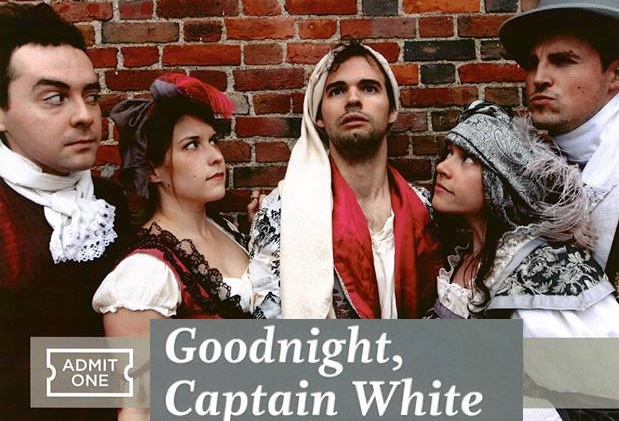
Goodnight, Captain White

a two-act comedy / interactive murder mystery with multiple endings – script available for producing

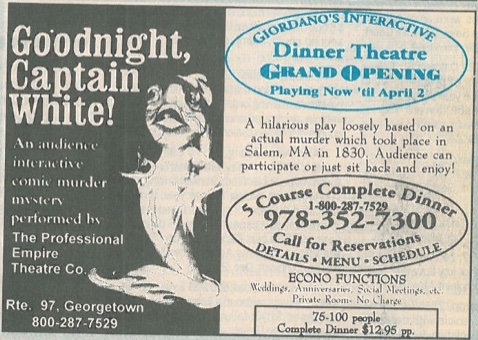
at Giordano’s Starlite Dinner Theater, featuring comedian Pete Holmes

Here’s a 90-minute, two-act comedy for six actors (3 m, 3 f) which can be interactive (in the mode of The Mystery of Edwin Drood and Shear Madness), perfect for dinner, community, regional and high school theatres, even Off-Off Broadway. There are five possible endings.

Interested in producing Goodnight, Captain White? I’d love to make it easy for you. Download the script here, and email me at mark dot stevick at gordon dot edu to talk details.

CHARACTERS
Lavinnia Beckford – The Captain’s niece and housekeeper. 40s-60s.
Abigail Knapp – Lavinnia’s daughter, the Captain’s grand niece. 20s-30s.
Frank Knapp – Abigail’s husband, the Captain’s former employee. 20s-30s.
Richard Crowninshield – Dangerous outlaw type. 20s-30s.            
Penelope Muchmore – Amorous harlot type. 20s-30s.                                   
Sen. Daniel Webster – Under cover as hired help; during the play he is mistaken for the manservant, Benjamin, and is wrongly thought to be deaf. 30s-50s. [also briefly plays Captain White – 82-year-old, wealthy sea captain – 2 lines]

SETTING
The library of the Captain’s house in Salem, Massachusetts.

TIME
Spring evening, 1830.

SYNOPSIS
Old, wealthy Captain White throws a party at his seaside mansion to which the citizens of Salem are invited. During the evening, a motley group happens into the library: the Captain’s niece and imperious housekeeper Lavinnia Beckford; her disaffected daughter Abigail Knapp; and Abby’s feckless husband Frank—along with two seeming outsiders, the enterprising Richard Crowninshield and the amorous Penelope Muchmore.

The Captain retires to change his shoes (too much dancing) and never returns to bid goodnight. It quickly becomes clear that the five in the library have good reason to resent the old man and are busily scheming to acquire his fabulous estate. The Captain must die intestate (without a will).

The five machinate with increasing agitation under the anxious eye of a sham serving man—who is really a detective in a clumsy disguise (doubles Captain White). When, at the end of Act One, the Captain is murdered, the serving man reveals himself to be Massachusetts Senator Daniel Webster (replete with whiskey). Webster appoints an audience member as deputy; then he and the audience reconstruct the suspects’ movements and assess their motives. The final outcome of the play (there are five possible endings) can be determined by the audience’s vote.

The play may also be performed without audience involvement, using the ending of the director’s choice.

pics from various Goodnight, Catpain White productions

A HISTORICAL NOTE
Goodnight, Captain White was inspired by a notorious murder that occurred in Salem on April 6, 1830. All of the characters in this script were players in the events surrounding that murder, though not as portrayed here. Daniel Webster, for example, U.S. Congressman and noted orator, was the prosecuting attorney during the trial of the Knapp and Crowninshield brothers.

Thanks to Karin Coonrod for commissioning this piece for Compagnia de’ Colombari productions in Italy and NYC, and to John Sarrouf for suggesting I extend my original cutting.

REVIEWS
“An ideal production for a dinner theatre” (Essex County Newspapers); “a provocative script…dialogue with the tone of a Gilbert & Sullivan operetta” (Lowell Sun); “A hysterical whodunit…both comical and personal” (Salem News); “Quick-witted, playful…a brilliant script” (Weekender); “a spritely murder mystery…dashedly clever” (Georgetown Record); “A zany who-done-it…it captivates you” (Eagle Tribune); “a tour de force…a fun worthwhile evening out” (Daily News of Newburyport); “Rich with innuendo…relies on a talented cast for improv and audience interaction…a night of good fun” (Destination Salem)

EXCERPT

Here’s the beginning of scene two, just after the murder has been discovered by Senator Webster (who has been confused as the Benjamin, the servingman). Webster drafts an audience member to serve as his deputy.

SCENE TWO

(continuous action from SCENE ONE)

LAVINNIA, FRANK & ABIGAIL are at the chaise; PENNY in one chair; RICHARD at the other chair. ALL are making a great deal of noise.

WEBSTER. I… I… I wish to be heard!

LAVINNIA. Who are you, you foolish man?

WEBSTER. Foolish man, that’s good, and fair enough thanks to this get-up, I am Senator Daniel Webster of Marshfield—

PENNY. Senator?

WEBSTER. That’s right, Senator Daniel Webster, masquerading here tonight as a simple serving man—thus the outfit—in order to observe the comings and goings of the guests.

PENNY. Your serving man is a Senator?—that is rich.

WEBSTER. Not the serving man in fact—

RICHARD. (shouting) YOU’RE NOT BENJAMIN THE DEAF MANSERVANT?

WEBSTER. NO!

PENNY. So you can hear us then?

WEBSTER. Quite well, actually.

RICHARD. Very clever, pretending to be deaf the whole time.

PENNY. (alarmed) Yes, ooo, he might have overheard anything, how—provocative!

WEBSTER. I had no intention of pretending to be deaf.

LAVINNIA. So this man is blind, then?

WEBSTER. HOLD IT!

ABIGAIL. Could you please sort this out for us, we’re fairly confused because, apparently, we’ve got a murder on our hands.

WEBSTER. Yes, at last.

LAVINNIA. Dear Captain White! (Sobs)

PENNY. (Weeps)

ABIGAIL. Oh Uncle! (Sobs)

FRANK. (Weeps)

(WEBSTER, having looked at each in turn, looks at RICHARD amid the din of lamentation)

RICHARD. (shouting above the noise) BET YOU WISH YOU WERE DEAF NOW, EH?

WEBSTER. All right! Now hear me—I understand this is a delicate moment, but there’s been foul play here and I intend to get to the bottom of it. Let me spell this out for you. As I said a moment ago, the Honorable Captain Joseph White lies dead in his bedroom above us, the apparent victim of a cold-blooded murder. The coroner has been sent for, and for the moment I’m placing everyone under house arrest.

SUSPECTS. House arrest?

LAVINNIA. What do you mean? Arrest the house?

WEBSTER. That’s very literal, but in a manner of speaking, yes. I mean no one may leave the premises without my authorization.

ABIGAIL. Surely an elderly relative of the deceased might retire to another venue—

WEBSTER. Not likely, Pikely.

ABIGAIL. Don’t call me “Pikely”.

LAVINNIA. Don’t call me “elderly”.

WEBSTER & ABIGAIL. Sorry—

WEBSTER. —as a matter of fact, by the end of the evening I expect one or more individuals here will retire to a venue bordered by bars and known as a jail cell!

LAVINNIA. How very gauche.

FRANK. One of us?

WEBSTER. All five of you, possibly.

SUSPECTS. Well!

WEBSTER. And gauche or no, I’m confining each of you to this overstuffed room until I’ve had a chance to question you individually.

LAVINNIA. Oh!—overstuffed!

FRANK. Question us?

WEBSTER. Yes.

ABIGAIL. About what?

PENNY. Yes, about what, and when do you start spelling?

WEBSTER. …

FRANK. Oh, you said you were going to spell out—

WEBSTER. I got it.

PENNY. I’m looking forward to the spelling. …S-P-L…

WEBSTER. I don’t know what to say to that.

RICHARD. Why don’t you tell us why you’re here, “Senator-Webster-disguised-as-Simple-Simon.”

ABIGAIL. It’s most curious.

WEBSTER. I expected you’d want to know that, and that’s why I have an answer for you. In brief, two days ago I received an urgent post from the late Captain’s solicitor—(SUSPECTS sniffle)—courage!—stating that the Captain’s last will and testament had been stolen from the Asiatic Bank.

SUSPECTS. Stolen from the Asiatic Bank!

WEBSTER. That’s right, Asiatic: A-S-Z-… Stolen. S-T-O-L-E-N; let the spelling begin. I continue: as the Captain is—was—(SUSPECTS sniffle)—courage—both rich and ruthless, he was no doubt the subject of a vicious scheme to pilfer his worldly assets.

PENNY. Worldly “assets”?

WEBSTER. … “Worldly assets.” I do not think that means what you think it means. I resume: whoever stole the Captain’s will plans to steal his estate. And I believe that someone (or someones) may be here tonight, hoping to machinate unobserved.

FRANK. Machinate?

WEBSTER. Machinate: M-A-S-H… Plot: p-l-o-t. I rally: and that’s why I’m here. To keep watch, because without a will a man’s fortune and his future are at considerable risk.

ABIGAIL. Is that so?

WEBSTER. It is. I like to say “Where there’s a will there’s a way; and where there’s none, there’s a war.” (HE enjoys his remark)

ABIGAIL. Brilliant.

RICHARD. Clear as mud.

FRANK. Huh?

PENNY. Ooo!

LAVINNIA. Balderdash and complete rubbish. Deaf or no, this is hardly a time for mangling perfectly good aphorisms—

WEBSTER. Mangling?

LAVINNIA. —nor for displaying your own undernourished wit.

WEBSTER. “Undernourished wit”—that’s a surprising usage—LISTEN LADY!—(SUSPECTS leap up)—just checking, just checking for a pulse. (SUSPECTS resettle) Fairly quick to action, I see, all of you are.

PENNY. Well, can you blame us?—after all, we’re a bit on edge.

WEBSTER. Edge?

ABIGAIL. Emotional, I believe is the point.

WEBSTER. Point?

FRANK. Look, to be blunt—

WEBSTER. Blunt?

LAVINNIA. Cease and desist!

WEBSTER. (Pointing to ceiling) ALREADY BEEN DONE, THANK YOU!

RICHARD. Yes, so you say, Senator. You say that our generous host lies murdered in his own bed. But none of us has seen the corpse—(SUSPECTS sniffle)—courage—and so we only have your word for it. “Murdered.” But is he dead? And just how dead is he? Was he strangled? Smothered? Or might he instead have died of anguished but natural causes, one hand on his foot, say, the other on his heart, gasping like a fish—

WEBSTER. Well done, Mister—Crowninshield, is it?

RICHARD. That’s right.

WEBSTER. I had hoped to catch you on some detail still hidden from view.

RICHARD. Obviously.

WEBSTER. But I see you’re far too slippery for that.

RICHARD. Only when wet. But let me press you further. You said that without a will, the Captain’s fortune and his future were both at stake—

WEBSTER. “Stake”?

RICHARD. “Risk” was the gentler way you put it.

WEBSTER. Kind of you to notice.

RICHARD. Oh, I noticed, too, Senator, that while you were pouring whiskey and passing out macaroons, the Captain was being BRUTALLY MURDERED UNDER YOUR VERY NOSE!

SUSPECTS. OH!

FRANK. He’s right!

ABIGAIL. Horrible!

LAVINNIA. You oaf!

PENNY. He IS undernourished!

WEBSTER. (To LAVINNIA and FRANK) Well, don’t forget, I’m deaf, so I couldn’t really hear anything.

SUSPECTS. Oh, right.

WEBSTER. (to RICHARD) That’s a very irritating remark, Mr. Crowninshield, and I’ll thank you never to make it again!

RICHARD. Touchy.

WEBSTER. No I’m not.

ABIGAIL. Let’s get to it—you have questions, ask them.

WEBSTER. Right you are, thank you. For starters, I’d like to establish who each of you is and why you’re here. Starting with you: what is your name, madam?

PENNY. I thought you’d never ask—my name’s Penelope, but my intimates call me Penny.

WEBSTER. Last name Penelope?

PENNY. No, last name Muchmore.

WEBSTER. “Much more”?

PENNY. Exactly.

WEBSTER. “Penelope Muchmore”—how apropos. Relationship to the Captain?

PENNY. Yes.

WEBSTER. So you knew each other?—I’ll rephrase: you were acquainted with each other?

PENNY. Quite well, Whiskeyman.

WEBSTER. Call me Senator, and what is your business here tonight?

PENNY. Pleasure, and call me Penny.

WEBSTER. This is going swimmingly. (To RICHARD) You, sir, please state your full name.

RICHARD. Richard George Crowninshield, but my intimates call me “Captain Killer.”

LAVINNIA. Oh, I knew it!

WEBSTER. Stay calm, ma’am, he may be the killer. And what is your line of business?

RICHARD. That’s none of yours.

WEBSTER. That’s correct, I’m a senator, and you are?

RICHARD. Not.

WEBSTER. Correct again. Two nothing, you, Mr. Crowninshield, but did you know the Captain?

RICHARD. Only to be a generous and highly principled man, Senator Webster. Beyond that—nothing.

WEBSTER. Well done, Mr. Crowninshield. First round to you, but beware: I’m not left handed. (Tosses pencil behind back off stage left-handedly; then, to ABIGAIL) As for you Miss—

ABIGAIL. Mrs. Knapp.

WEBSTER. Beg pardon, Mrs.—

ABIGAIL. Abigail Knapp. Grand niece to the Captain. My mother; my husband, Frank.

WEBSTER. (to FRANK & LAVINNIA) A pleasure. (to ABIGAIL) Where do you reside, Mrs. Knapp?

FRANK. We live in Wenham—

(WEBSTER silences/slightly strangles FRANK using The Force, à la Obi-Wan.)

WEBSTER. (to ABIGAIL) You were saying?

ABIGAIL. I wasn’t.

WEBSTER. Correct as usual—I see you have a keen intellect.

ABIGAIL. Only compared with some.

WEBSTER. I may take offense at that remark, but first, do you live here?

ABIGAIL. I live in Wenham.

WEBSTER. Yes—with mommy and hubby?

ABIGAIL. Only with my husband, Senator. Where I can devote myself entirely to him.

WEBSTER. That’s a seemingly inconsequential remark, Mrs. Knapp; I may choose to ignore it. (to FRANK) You sir, Mr. Frank Knapp.

FRANK. Yes, and I apologize.

WEBSTER. For murdering the Captain?

FRANK. No!

WEBSTER. You don’t apologize for murdering the Captain?

FRANK. No no!

WEBSTER. You must bear him a great grudge to be so unrepentant.

FRANK. Well I, I—

WEBSTER. And don’t think I didn’t notice you just said “I” twice in a row.

FRANK. I—

WEBSTER. And that’s three, Franky! Which brings me to you, Mum.

LAVINNIA. I don’t see that it does.

WEBSTER. I bet you don’t see a lot of things.

LAVINNIA. I don’t see why you should see that.

WEBSTER. And I don’t see why you don’t see the reason I should see it!

LAVINNIA. Oh!

WEBSTER. Heh heh. So let me ask you: what is your name and relationship—

LAVINNIA. I am Lavinnia White Beckford. I am the Captain’s only niece.

WEBSTER. And why are you here?

LAVINNIA. My thoughts exactly. I should be resting my poor astonished heart elsewhere.

WEBSTER. Interesting that you should say “heart”—what I’m asking is did you float in like Moses, or—

LAVINNIA. This is my home.

WEBSTER. This is your home?

LAVINNIA. Yes, I reside here. Here is where I reside. Your powers of observation are sadly deficient. I happen to be the mistress of this house.

WEBSTER. (Looking at PENNY) The “mistress”—oh, I thought that position was taken—

PENNY. It is. She’s the housekeeper.

WEBSTER. The housekeeper?

LAVINNIA. The housekeeper, yes.

WEBSTER. Very well. I’ll be questioning you all in greater detail shortly, after the coroner has examined the body. So don’t drink heavily. Call me crazy but I have a sneaking suspicion that the solution to the Captain’s murder is to be found in this very room.

SUSPECTS. YOU’RE CRAZY!

WEBSTER. That’s irritating. Now: I need to speak with the other guests as well, so I’ll need someone to keep an eye on things here while I’m gone—someone imminently reliable, with a trustworthy face and a confidence-inspiring manner. Someone like—(to some guy in audience)—you, sir. What is your name?

(WEBSTER gets name and ad libs with new DEPUTY.)

WEBSTER. [Some Dude], I’m hereby commissioning you as Deputy [Some Dude] of Essex County; congratulations. Deputy, your assignment today is a sober one—sober, Deputy?—and that is to ensure that these five suspects don’t conspire to escape or to molest moi. And beware that they do not entice you into any inappropriate behavior, Deputy.

PENNY. Define “inappropriate.”

WEBSTER. (to DEPUTY) See what I mean, Deputy? Can you define it? Can you spell it?

PENNY. (to DEPUTY) Don’t I know you?

WEBSTER. She “knows” you, Deputy?

PENNY. (ad lib)

WEBSTER. Oh good: find a Penny, pick her up, eh, Deputy? Now while Deputy [Some Dude] keeps an eye on Penny, I’d like to talk with any of the rest of you who may have seen or heard something which might help me solve this crime. Incidentally, I’ve also prepared a tasty selection of bon-bons which you may wish to sample in the parlor as well. None for the Deputy; he’s working. On saving his marriage, ammi right, Mrs. D? (to audience) So, we’ll take an intermission [fade up intermission music] while the Coroner does his business, eat some bon-bons, and if you’ve witnessed anything fishy tonight, please let me know.

(MUSIC begins to swell)

PENNY. Oh, Senator?

(MUSIC dips)

WEBSTER. Yes?

PENNY. I was just hoping I might sample your bon-bons myself…

WEBSTER. Tickle me with a tuna, an innuendo from the escort! Get to work, Deputy (MUSIC swells), that’s the kind of behavior I’m talking about!…

(The SUSPECTS begin exhorting the DEPUTY for this or that, as the light FADE and the MUSIC peaks.)

END OF ACT ONE

(The actors may remain onstage during intermission, and may interact with audience members. They will get a break during the one-on-one interrogations upcoming.)


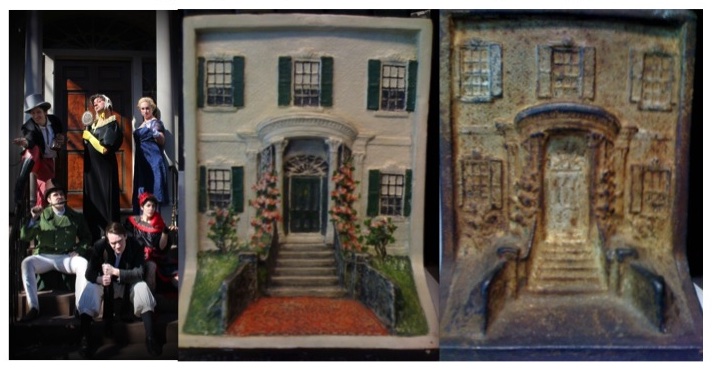
the Gardner-Pingree House in Salem, where the actual murder occurred (reliefs by Sarah Symonds)

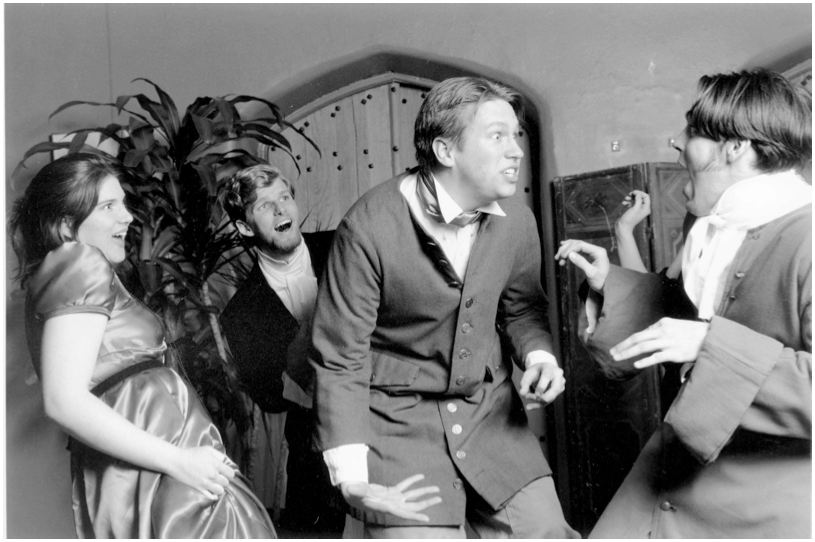
original cast members Ina Buchanan, Marc Fillion, Pete Holmes, Daniel Wall

available script two-act play interactive murder mystery 90-minute play 6 actors one set community theatre regional theatre dinner theatre high school productions hilarious comedy history mystery multiple endings community theater dinner theater regional theater

Introduction – to Andre Dubus III

Andre Dubus III caught in our consciousness in 1999 or 2000. It was that novel of his, with the enviable title, House of Sand and Fog. Enviable, evocative.

We ourselves weren’t big into Oprah, who herself was big into his book (but I think that was after we’d already read it—we were ahead of the book clubs, just like Vadim Perelman, who tapped our guest for the rights to make it his first film, starring (why not admit?) one of our acting heroes, Sir Ben –
Kingsley).

But that was 2003, so let me sidle back to ’99 when we first turned over that savor-able title page.

What we remember is the Iranian colonel on the road crew, in the broad heat, with his trash bag and picker, his remote dignity under the squalid duress of his boss and sidecrew, unfolding his sack lunch of tea and radishes beneath a shade tree—Behrani, so courteous and unfathomable to the others…

This scene we remember rhyming with a work scene from another book: a kid/man digging trenches in the booming sun, Louisiana, his pick axe and shovel, and tough men with tougher hands, forgoing his lunch of sugar and lemons, sleeping it in the shade of a shed—his youthful prescience and resolve, so remarkable in his way…

—that scene written by Andre pére, father of our reader tonight, his book out the same year as his son’s, Meditations from a Movable Chair, 1999.

There must be a fire inside you to match the one outdoors, says the colonel-crewman.

I tasted a very small piece of despair, says the man/kid.

Twain scenes, of harsh senses and sensibility, of labor and lunchability, that make me wonder about this Dubus family craft – of writing: did the habit of art get handed down, passed along? It seems so. But how so? We may read about that in Townie, if we wish, which begins with another habit, too, the habit of pain, father and son running hilly, looping miles together, years before these two books I’ve mentioned.

—these books, son’s and father’s, that were passed along to me by our writer-saint, Lori Ambacher, fictionist, essayist, poet, friend of the Dubuses, too, who somehow ended up in Andre-father’s writers workshop. (If there was too much light in the room, it might have been Lori herself.) Lori who taught here at Gordon for twenty years, literature, conversating, creative writing. Lori whom we cherish and honor with this reading and this year’s Writers Series. Grove, Lori’s longtime partner, we’re especially glad to greet you tonight.

I think this introduction, now nearly at its end, has been more for Andre and me than for the rest of us here—I apologize for that.

But, really, how much introduction is needed? Nine books, three kids, one love-of-his-life, all jumbling around in a house in nearby Newbury that he built with hands hardened by #2 lead pencils.

Thank you, Mass Cultural Council; thank you, Lori Ambacher; and thank you, Andre—or as Lori called you—ladies and gentlemen, please join me in welcoming “Andre Three.”

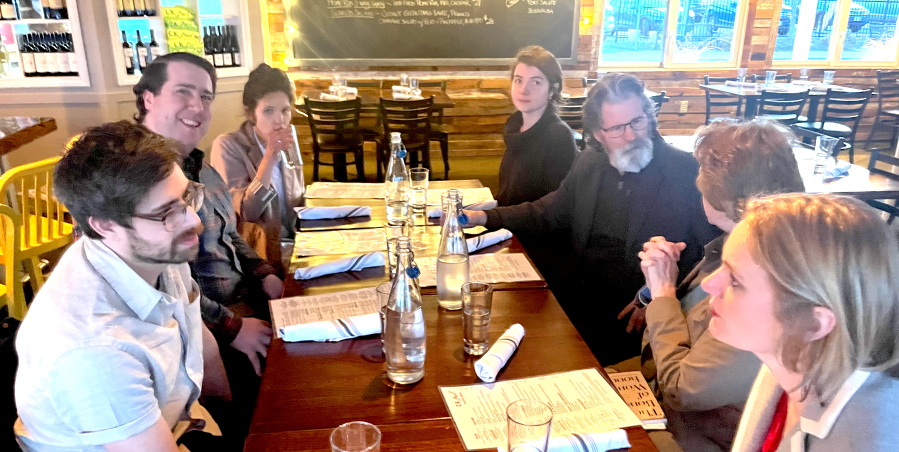
Pic from our dinner with Andre: Gordon writer/profs Bryan Parys, John Mirisola, Sophie Wetzig, Michaela Greco, Andre Dubus III, Andrea Frankwitz, Kerilyn Harkaway-Krieger

Introduction – to Micheal O’Siadhail

We first met the poet Micheal O’Siadhail at Gordon in 1997, at the college’s production of Dancing at Lughnasa—thanks to philosophy professor and expert whistler Grady Spires.

I have a program here that proves that date: Micheal is specially thanked herein.

I should say, “We met the excellent poet Micheal O’Siadhail,” though, forsooth, I didn’t know any of his poems then. We knew him first as a dialect coach pressed into service to help us pronounce the play properly. But (to quote the opening line):

When I cast my mind back toward that summer of 1997, different kinds of memories of Micheal offer themselves to me.

Brian Friel, the excellent playwright of that script was a great friend of Micheal’s—two admirers of the other’s art—and both lovers of the 2B pencil, as it happens. (Some of you may not know their work, yet, but you already share their loyalty to the soft lead-and-clay of the 2B.)

They were friends, Micheal and Brian Friel. I could say, “Of course, they were friends”—but that’s a bit pushy, a bit too easy.

Which Micheal’s poems exactly aren’t.

They’re not easy, as in facile. Not “easy” as Richard Wilbur uses the word in a poem to his young daughter who, while typing, “…pauses / as if to reject my thought and its easy figure.”

And Micheal’s poems are not easy formally, with their stalwart meters and jazzing rhythms and believable rhymes, though the poet’s skill with these elements orchestrates them, harmonizes them, and the language fall easily, pleasurably on the ear. Here is Ars est Kelare Artem — Micheal’s art is to hide the art, not easy at all to do.

His poems—what can I compare them to? Today what comes to mind is fine watches: I’ve been lately enjoying videos of these beautiful, intricate, reliable-and-useful engineering marvels, Rolexes, Patuk Phillipes, others, being restored—admiring their complex inter-relying parts, the jewels, all coordinating in a lovely portable shape that delivers the beauty of the exact time with our easy turn of a wrist.   

An easy figure, but that’s as close as I can come.

Hearing these marvels of his read aloud, as we first did in 2014 with his Collected Poems, or again in 2017 with One Crimson Thread, we will marvel at how the turns of line and phrase deliver the beauty of exactness to our ear and, yes—allow it—to our hearts. When Micheal reads to us, “A stillness greatens, in which / the whole house seems to be thinking” (Wilbur again). Twice before in Jenks 237, from front-row center to the second mezzanine, the stillness greatened, and greatened again, and the whole house seemed to be thinking.

Remarkable and rare is the experience—and the poet who gesceaps it. 

I don’t need to tell you he’s published 17 books of poetry and won many prestigious prizes for them.

You’ll know that soon enough after I welcome to your house this afternoon: the excellent Micheal O’Siadhail.

Poem – Gray Suit Coat

Gray Suit Coat             

It’s remarkable the way, once you’ve started,
almost anything will work: telephone poles,
a pile of wood, a steeple. Farming
implements are lovely, and everything
in the garage, for that matter. Even fabrics,
if displayed correctly, can be effective:
take for example the suit coat on the chair,
say that the shoulders are square
and the creases sharp, and that the sleeves,
though worn, are spotless. Mention the way
the bow of the hanger lifts the lapels slightly—
all of these details have consequence.
No one will bother about motive
if the beam that you drop rings true
or cuts clean. Move the stepladder around
to the far side of the barn. Only avoid most 
adjectives, and the moon.  
Now: what about that gray 
suit coat hanging on the back 
of the chair, open at the neck?

Poem – Poem with Crow

Poem with Crow

for my daughter

I give you
in morning a man splitting wood
in March a man’s cut breath sudden
and the perilous beauty of steel arcing
around him

see how the
plaids of his coat are busy they
gather and flex for the keen wedge,
gather him to the greens and browns of
the pasture

I say the
greens and browns of sleeping horses
greens and browns of wet wood
this man stables for the splitting edge
in this March

I tell you
I am this man in morning
I am the wood and horse stabler
and it is my work unharnessed
in the axe

O the axe!
its bright weight a word for wood,
its quick insistent
talk in the ear, in the struck and
plied fibers

and how the
fresh hewn logs yield a fragrant hue,
yield such filaments of flesh I
cannot taste, cannot yet embrace
nor ignite

into this
(now the sharp waking of wood and axe
beneath the early mottled trees
beside the pasture-mantled mares)
March scene walks

jet, one crow
jet he is charcoal, he is his shadow
he is nearly not, an inked and
unblinking pupil at the center of
my fancy:

think of me
busting limbs by the waking sires
bursting steam in the unbuttoning sun
by the bark-strewn stump and the axe
as I say

this black stroke
this impudence of sheen, this concentrate
of crow crutching across the roots
grotesque as a straight-jacketed
lunatic

was for me
a figment of a child I’ve not conceived,
a girl bearing what resemblance? to
this masked crow, eyeing me, turning
now its back;

such magic
in the burning March mid-morning
in the soft piles of flushing wood
in the right dominion of the horseshoe
and the axe

I saw my
black-bound daughter unmanacled as flame
in the pomp of every feather, mighty
in the muscling of flight, galloping, split-
ting the air

-Published in Wild Plum, winner of the Wild Plum Poetry Award.

Poem – Burnt Bus

Burnt Bus

Left in a lot, one where a building stood
or one widely fenced and piled with odd iron,
one where the scrap man spits from his tin shed,
left in these unruly lots is the bus,
burnt, or half–demolished, propped up on blocks
but looking still in all this wilderness
like a bus. No matter its vacancies,
glass burst into random, unmelted hail
in the ribbed rubber aisle and fraying seats,
all the engine innards ransacked and loose;
no matter its vacancy at the wheel,
the great, flat wheel which so many times I
would have swung into wide, flat revolvings,
turning round and through the narrow canyons
precisely, with precious inches to spare––
this is not a vague, derelict metal:
the rust is bus–like, and can still compel
pedestrians with pockets of nickels
to run. The placard spells 11th STREET;
someone must have driven it here, of course,
and it looks as though he will be right back––
the door is open. I imagine how
he parked here with that particular skill
of bus drivers, using the wide mirrors
and the various signaling lights; then,
taking the keys, how he pulled the handle
and descended as he would step slowly
from a train to the platform at Cripple
Creek or Canyon Gulch, and walk, uniformed
and solitary, listening for wheels
on the rails as the sun–filled coach pulls out.

-Published in SWINK, and winner of the SWINK Literary Award in Poetry, chosen by Tony Hoagland.

Poem – A Stadium Full of Bears

A Stadium Full of Bears

There are 7,500 bears in Pennsylvania. If you put
all those bears in a stadium—that’s a lot of bears.
-my dad

As the rows fill up, there would be the usual
jostling and scuffles over seats. Even before
the kick-off, imagine the noise from the stands.
Think of the lines to the women’s rooms,
to say nothing of the tussles outside Gate E
to the cheap seats. Vendors hawk fresh peanuts
over a din of growls and complaints about
parking or ticket prices; chums discuss Greenpeace
or annual weight gain; someone points out how
you could make a killing here on smoked salmon;
and everyone is generally ignoring the scoreboard
and adjusting their scarves and seat cushions as they
assemble, everywhere a bear, a common species,
a stadium full of bears growling and shrugging
and sucking their paws, negotiating for a little
space and a decent view, getting ready—the bears
are getting ready for something to happen, something
important, something truly out of the ordinary.

-finalist in the Aesthetica Creative Writing Competition, and published in Imago Dei.

Poem – Waiting Up

Waiting Up

There’s a table in the center of the room,
and the ceiling is ochre and very close.
There’s the sound of rain and nobody is home—
nobody else who can help hold up the house.

There’s a black lacquer table and it’s holding
a candle that stands beyond the windowpane;
its fire is polished brass and barely moving,
and the midnight sitting room is dark as rain.

Upstairs the air is dark but the bed is made,
there’s a book somewhere I haven’t been reading.
Downstairs the bookshelves have been newly arranged,
and the black lacquer tabletop is peeling.

Wax has been tarnishing the brass candlestick,
and the edges of the flower are folded.
Although the sharp edges of the flame reflect
in the picture frame the faces are clouded.

All the room’s dark furnishings conserve their strength;
the black table bears what I need to survive—
the taper, the portrait, and the hyacinth.
When I get up, all the windows throw their knives.

-Published in Best Poem and Plains Poetry Journal. “Waiting Up” was a finalist in the Art in the Air (WPON, Detroit) and the Spoon River Review poetry contests.

Poem – After Shunning

AFTER SHUNNING

                                     -for the Treuherzigen

i. Out of the Dark

The footprints I follow to my door
are mine, and the clutter on the table.

This poem is wrong, because I
have been straightening up for months.

Today when I woke, the air held
the packed silence of snow.

If you came tonight, out of the dark,
snow would slide from my roof.

ii. Just This

Pines on a February afternoon.
Is this enough?—the salt–white road, the half-
hearted walls piled with cinders, a few leaves
leaping up. No one has been kissed, nothing

written. Between towns, an ocean glimpse
is aqua-marine, extravagant. Leaves
leap up. There is water, and sky, then just this
wide light on the needles beneath the pines.

iii. Past Places

These roads again, empty, winding past places
I have known: the frozen shipyard;
the fish house, shuttered up;
the burial ground, still swallowing itself.

Downtown, February snow dozes on doorsteps,
but the avenues here are salt-dry, and rows
of whitewashed houses are remembering the sun.
Every sunlit clapboard is a pang.

iv. What if Bass

In the wood duck’s wake the cypress dimples;
red-winged blackbirds are thrilling the cattails;
wind or water striders ripple the doubled shore.

So what if bass make their unfathomed rounds
or if the moth scribbles his erratic map?
The beaver’s tail is the mad slap of hope.

v. Who Would Not

This October woman crossing a stubbled field,
her hair black and her daughter blowing,
her hair blacker far than the stripped limbs;

who, when she looks up in that field to ask,
(her hair black as crow, blacker yet) who would not
furnish her from his breast one fire-tipped cigarette?

vi. This Birch

Civility rises as this birch
lifts its face, and stretches.

There is remembrance in these limbs,
of wind, and rain, and mute kisses.

All the gestures of the branches say
the gifts I bring must be refused.

Let this tree be dressed as light allows;
let it be white amid dark boughs.

-The poem entire. Winner of The Shine Journal Poetry Contest.

Poem – Bob’s Big Boy

Bob’s Big Boy

comes in
where the miracle happens
again today,
sidles up to the conversation
which never changes like the menu
except for the specials
and hears his name handled confidently
in quadruplicate
and glances over impressed and humble
faces of not-so-regulars
like boring headlines
and fumbles in his shirt for a smoke
and takes a light and a deep drag
before tossing out “Thanks” like a quarter tip
then sees her,
coming toward him,
and sets his watch again as she comes forward
forward bringing his water
right up across the counter
so that he must notice it slide
slightly on its wet cushion and the
square circle ice goes slosh against the
glass with the love handle around its
sweaty waist
and reaches knowingly to accept it
then watches her hands that
dip and feel in the
folds of her orange apron,
down and hidden in
and out again with a pad and pen
and waits for her to ask and says the usual
and she says what’s that and he straightens
and repeats it looking at the pad and wiggling pen
and rolls the glass between his fingers
as she pours his coffee and drops a couple of
Half and Halfs
then walks away with a walk that
makes him hurt.

He reaches for his cigarette and sucks his coffee
in the sound that is his thought
and thinks a while of silverware and glasses
and wonders for a moment in the ache of bacon if
he might just–what was it?
when her hands come bearing plates of food for him
a refill and presto one two no three!
Half and Halfs from her apron
and he smiles back at his eggs
and lovingly begins to eat his number 5 with hash browns
and oh the eating fills him up and makes him hungry
in this friendly restaurant where he brings
his need.

And the salt flows free
and the ketchup rolls slow
until at last again she comes,
his waitress,
wiping spills, wiping round under ashtrays
rainbows round,
wrists dipping softly in her apron
for a pad or pen and things and things
and maybe if he asks who knows she’ll
pull a rabbit out or even–dipping
and wiping and scooping up
tips all at once, all at once, and
he sips his cigarette and smokes
his coffee as she tames him with her
vanishing hands he knows would smell like
dawn if he could only
cig his siparette and cough his smokee
and laugh with the ring of the register and the
talk of plates and glasses being
swung around so easy in this
busy neighborhood and where the
streets all smell of bacon and the
cabbies call him Mayor and the
weather’s on the menu and the
sunny side is orange and the
whole confounding world is round and round and round
and round.

-Published in Literal Latte, and winner of a Literal Latte poetry award. Written when you still smoked in restaurants, and servers brought water without being asked.

Festival Introduction – to Kwame Dawes

Kwame Dawes keeps busy. He’s got irons in the fire.

Literal irons—?

No; you and he are good with metaphor: more on that anon.

Kwame is firing so many irons at any given time he might could be a farrier, fettling bright, battering sandals. Some examples of this:

-the Founder of Calabash International Literary Festival…seeking to transform the literary arts in the Caribbean by being the region’s best-managed producer of workshops, etc.—Kwame Dawes.

-the Founder of The African Poetry Book Fund…developing and publishing the poetic arts of Africa through programs and collaborations—Kwame Dawes.        

-the editor of American Life in Poetry…finding and publishing poetry that speaks to various aspects of American existence—Kwame Dawes.

Maybe Kwame’s are actually clothing irons, the old-fashioned sad irons you’d heat in the fire—

Well, here, then, are some of those:

Kwame is editor of Prairie Schooner, AND founder of the South Carolina Poetry Initiative, AND creator of the project “Hope: Living and Loving with HIV in Jamaica,” AND poetry professor at two universities…

Goodness!—With all this, you won’t be surprised that Kwame was recently appointed the Patron Saint of Ironers-in-the-Fire—taking over for Leonardo de Vinci.

And, of course, he keeps writing poems.

When you go online for poetry, you will likely see his face, a kind face, one whiche betokeneth his character.

This “irons in the fire”—isn’t really a metaphor, is it? More a figure of speech now, lifted from the common places of our lives, our lives full of particulars. “It is only,” he says, “in the mastering of the particular and the parochial that a sophisticated universalism can be achieved.” This masterful use of the particular is one of the things we admire about his poetry—

—what he does, for example, with pieces of scrubbed clothing hung out to dry, as in these last several couplets from “Ode to the Clothesline”

…taut lines, propped by poles
with nails for a hook, above

the startling green of grass and hedge,
the barefaced concrete steps,

the sky, inscrutable as a wall;
this is what one carries as a kind

of sweetness—the labor of brown hands
elbow-deep in suds, the rituals

of cleansing, the humility of a darning
or a frayed crotch, the dignity

of cleanliness, the democracy of truth,
the way we lived our lives in the open.

We savor the modest, apt description—of a startling green, a barefaced concrete, a sky inscrutable as a wall, and then that finish, where real laundry lifts into something universal and valuable.

This is uncoding landscapes (and histories and epiphanies) by things founded clean on their own shapes.   

And this is one of the many pleasures and skills and marks of his work. I’ve read lots of it recently. Ilya Kaminsky, festival friend, says, “Why read Kwame Dawes? Because you cannot stop.” Exactly.

I know this too-long & too-brief intro has run a tad cheeky: It’s because I just can’t match the admiration I feel for him—his commitments, his rigor, his abundance, his joy-bringing. Even so, Kwame, I take heart from your remarking that “We are reverential by our noise and by our silence.” I bring you both.

Kwame Dawes is the author of novels, anthologies, nonfiction, and plays—along with 22 poetry collections—the most recent being Nebraska. Last summer he was named a finalist for the Neustadt International Prize for Literature.

Kwame, it is our great honor to have you address our festival today—in a craft talk entitled News from the Middle Way. Welcome, Kwame Dawes.

Festival Introduction – to Patricia Smith

In certain sessions, in certain chambers this week, what was heard – from certain stages, from certain specific rostrums, from podiums therein – what was spoken – out from prosceniums, what was finally heard, spoken—

Listen for the voices you don’t hear, our poet-at-large adjures – urges her own students. Write those unheard voices.

And she shows them – she listens-them how. And those listenings surely become her.

This week in 5 performances, at 4 high schools, to 3 thousand students, over 2 days, our 1 poet-at-large (even-larger than that) loosed mute voices into ear-ful auditoriums of students in this our Palm Beach Country. [sic]

And we – we, down in our all-unprepared seats – numbered seats and comfortable – what we finally – who we finally heard:

Child of – 6th-grade-children of lost mothers—
mothers – of once-sons, was-daughters—
daughters – throats crammed full of rivers—
other mouths now drained of names.

Say the teachers-of-Palm-Beach: Our students have been hit hard by this stuff. They’ve lost—. You can’t know—. These poems—.

There amongst them, sitting in a soft seat, legs languidly crossed, listening, listening to her, to them – how can I not rise to my feet?—

Because – upright.
Because – hear the X’s kissing as they cross.
Because – again – the chamber-mouth is empty.
                    And there’s my son. My son.

Would that no one dast speak such words.

I’m saying weakly what’s been said well in untold reviews, releases, citations: from Kingsley Tufts, Lenore Marshall, LA Times, National Poetry Series: Do we all attend and mark this poet.

And Jenelle, too, (she, student, who read all seven of Our Poet’s books to prepare for her fine memorized introduction before her peers) twice today affectingly said, “By being a four times National Poetry Slam champion, she gives indelible public voice to the many too-long silenced.”

Yes, Jenelle. I wish I were introducing you to reprise.

But it’s me, so, more plainly now: Our poet-at-large, and our reader tonight, hails from Chicago. She teaches at the College of Staten Island, where she was recently made a distinguished professor of poetry. Her first poetry collection, Life According to Motown, appeared in 1991; her fifth, Blood Dazzler, was a finalist for the National Book award; her seventh, Incendiary Art, was a finalist for the Pulitzer Prize. Miles, Susan and Blaise sagely invited her to be our 14th poet-in-the-schools; you have alertly come to hear her tonight.

Darlings, any jazz could be ours, and tonight her jazz is. Please join me in welcoming back to our stage – Patricia Smith.

Delivered at Patricia’s 2020 Palm Beach Poetry Festival reading in the Crest Theatre. During the festival, impeachment hearings were going on in Washington, D.C.

Festival Introduction – to Tyehimba Jess

This is a poet’s introduction, not a news story, but it’s got a lede, and I don’t want to bury it. The lede is this: that actions in our Florida state capital—certain capital offenses, chewed, swallowed and digested—have rippled their way to the poems that Our Reader Tonight, our poet-at-large, brought to three thousand students in five sessions over the last two days at high schools near here.

Just yesterday morning, our poet reminded auditorium-fulls about blackface, opening for the students on a big screen an ancient primer on the technique of blacking up—the burning of corks, the grinding-of-them into powder, the adding-to-them of petroleum jelly. And the application onto the skin… “So easy for gentlemen, and ladies, too.”

Then this morning at breakfast our poet read about this state’s secretary in the New York Times.

The Times, which aren’t a changin’, not enough.

Even before the object lesson, we knew: Our man’s poems are news that stays. For seven years he was devoted to the daily work of recovering personal histories from previous centuries, histories that resonate personally now—for him, and for us; for readers of The Times. What he made from them was Olio, a chronicling in poetry—part performance, part blueprint, part eavesdrop, part chant—in new forms that first engage the reader’s volition, and then step out from the sewn sections into volumes that stand. And deliver.

To encounter these poems is to remember that their speakers—Blind Boone, Box Brown, the McKoy sisters, Edmonia Lewis—each of them troubled this actual air with larynx and embouchure, with sound waves that are rippling out yet, diminished but factual, toward Ultima Thule—and that the sensibility, the instrument that catches – and renders – and returns them to us must be very fine, indeed.

Indeed, it is.

And prescient, too.

Tyehimba Jess is a native of Detroit who lives and teaches now in New York City. His first book, leadbelly, won the National Poetry Series. Olio, his second collection, won the Pulitzer Prize.

It’s with great pleasure and gratitude, Tyehimba, that we welcome you to our stage tonight.

-Delivered in January at the 2019 Palm Beach Poetry Festival. Tyehimba was scintillating and warm & welcoming to students, festival goers, and to me.

Festival Introduction – to Aja Monet and Elizabeth Acevedo

A highlight from this festival is an event that only I and Dr. Blaise Allen get to witness—which is when, in sequence, two poets step to a lone mic in front of a thousand sullen students—and read, and perform.

I could have said, “perform magic,” seeing as how these poets can turn students from timid rabbits into rabid tigers.

—or maybe said “perform surgery,” on account of how these two stand up to stimulate the internal organs of empathy and recognition and resolve.

Is it too soon in my intro for all this?—to say these two poets perform a thousand acts of justice and mercy and salubrious upbraiding—in high schools?

Well, that is what they do—to those “thousand sullen students.”
They perform, they perféct, they deliver, they detonate certain time lapse detonations.

They make, of those students, a thousand splendid suns.

I said “two poets.” It’s true I could have said “raconteurs, rhapsodists, scops, bards, balladeers.” I say again: two poets, who assess from the page, and arrest from the stage, with throat & tongue, and timbre & timing & gesture—in form and moving. How express and admirable.

I say móre: these just poets justice; keep grace—thát keeps all their sass and sauce.

I said we “get to witness.” I could have said we “get in the midst of”—“get mixed up in”—because to engage their poetry with eyes & ears is to engage it with skin, and follicle, and capillary. Even tear duct.

As I have seen, and you will shortly know.

Please welcome Aja Monet and Elizabeth Acevedo to our stage.

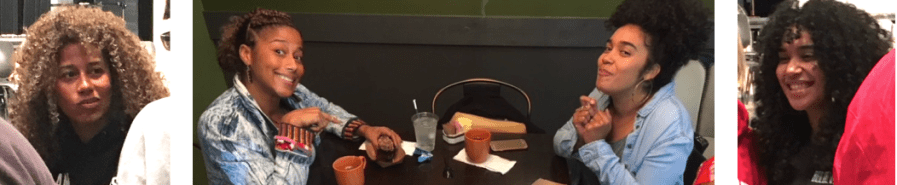
-Delivered at the 2018 Palm Beach Poetry Festival. Aja Monet (above left; her poem “The First Time” is here) and Elizabeth Acevedo (above right; her poem “Hair” is here), brought brilliance to schools and the festival stage.

Festival Introduction – to the Mayhem Poets

For the last couple of days, while the poets in Old School Square were workshopping and craft-talking, our two guests tonight were word-cajoling in high schools around Palm Beach County.

This is proper & fitting, because for the last half-score years, while we-all were on vocation, so were they—

vocationing—verbally, vocally, day-in and day-out, in theatres and gyms like this one all around the world.

And yesterday, while our new president was trumpeting in the streets, children in those same schools were dying – with laughter, and holding their breath, and handling words at once true and kind—

kind because vulnerable, and therefore full of power and authority.

Watching our guests from a fold-down seat didn’t just make me want to be them—
to imp my wing on their wit and talent and savoir faire

watching them made me mindful of,
grateful for those first permissions we all felt to love a poem—
to “belovéd a poem,” by Simic, or Perillo, or Roethke—and hear that voice that spoke up from the page, to us.

And for.

That’s what our guests are always up to, gig-after-gig,
voicing live from the stage what is scary, and scandalous, and scanned,
and granting permission to folks-young-as-we-were to speak—
and that in poems.

Here’s a little video of a student slamming a poem for them after one of their shows…
(Kidding—we have no screen here. But it happened.)

Legit now: Mason, Scott, hanging with you has been a highlight for me this week.

Year after year, you
bring the Mayhem Poets, you
get mayhem, poets.

Please welcome them to our stage.

-Delivered at the 2017 Palm Beach Poetry Festival. Scott Raven and Mason Granger (l to r), two of The Mayhem Poets, regaled a couple thousand students with poems like these.

Festival Introduction – to Poet Marc Kelly Smith

Robert Pinsky says that poems are musical scores, to be performed by the instrument of the body. The lungs, ribcage, larynx, the tricky tongue and shaping mouth (some of you heard Kevin Young mention embouchure), the resonators of skull and nasal passages, upheld and amplified by the diaphragm—all these concert together (with pitch, posture, and pulse) to release a poem’s music—

And I haven’t mentioned the face, its members express and admirable as a portable Mummenschanz.

Well. Our guests tonight would seem to agree.

What do you need to know about them? Little to nothing, I expect.

Should you know that Marc Kelly Smith invented the poetry slam at a Chicago bar in 1984, and that he’s been doing it nonstop ever since—a three hour set at the Green Mill every Sunday night, the longest running show in Chicago and poetry slam history?

Does it matter to you that, though there are manifold films/CDs/books about slam, Marc has kept on resisting the co-opters and franchisers with a sweet old-fashioned belief that poetry SLAMS BEST on the fringes, in real bars, in real neighborhoods, in gatherings of the original and inexpert?

Does it make a difference to you that, over the last two days, our man engaged a couple thousand high school students, embodying how a shy person can trust and venture LANGUAGE—and that he got all of them performing, and dozens of them up on their feet, mics into their hands, their voices fat in surround sound?

Should you be forewarned he doesn’t think of himself as a slam poet?

—or that, even so, he’s complained publicly about effete poems feebling forth from page or stage, so that this week our chevalier, Miles Coon, may have greeted him with, “Why am I bringing you to this festival?” (But, of course, he did—a tribute to both.)

—or, finally, that after the DuhamelLuxShapiro reading on Tuesday, this man, who seems never to need a printed page to bear The News, exclaimed, with his slightly Chicago vowels, “That was fantastic. So good, that if I’da heard dem when I was young I wouldn’ta had to invent slam poetry!”

I don’t know if that stuff matters to you now as he approaches the stage. And truth is, you’d get it all for yourself; so this intro is just me glossing the goods beforehand.

Here then, more chastely: Following on thousands of performances in nightclubs, concert halls, libraries, universities in venues worldwide, he brings his malleable, effectual, appealing self to our precincts tonight.

Here is all you need to know.

Welcome, Slampapi—Marc Kelly Smith.

-Delivered at the 2016 Palm Beach Poetry Festival.

Festival Introduction – to Poet Dominique Christina

Having learned a lesson earlier, I hope to carry fewer coals to Newcastle in this introduction of the poet Dominique Christina.

The catalytic Dominique Christina, I might effuse.

But you will shortly write your own superlatives.
What, then, will suffice for me here?
A few instances, perhaps:

—OK, for instance, Dominique Christina didn’t begin, hadn’t thought of performing a poem until six-or-so years ago. She was writing poems—her first, best love. Then some-smart-one said, “Dominique, you should stand up and say these things.”

—for instance, what was she doing then but teaching English, to students with certain troubles who, but for the grace of Dom, were headed down and out, maybe away, maybe for good. A dozen years’ worth of alleged incorrigibles have leapt to her high bar, looked for her kindly lash, and got her good graces in the classroom.

—for instance, when regarding a stadium-full of high schoolers, like she did this week, she will not stir the sanctioned myths of sweetness and light, will not denigrate or prevaricate thereby. She will cut what matters, cut quickly to your matter. Hear me: Were you there, you would watch 800 embodied aspirants writhe, and recognize, and rise to their feet at her accurate beck and call.

—and for instance, you would watch them come boldly forward to meet their provocateur, to touch and hug her, and be hugged hard in return, and to take selfies—yes—

—and (for instance) what MAKES them crowd into the frame with this secret sharer, this slinger of dark-and-bright, is nothing like what compels a pic with Beyonce or Bruno. What is it that compels? It is what she tells them in words and non-words: “You are magnificent. The world needs you. And you gotta SHARE you.” For that, we all get in line.

Jamnasium, I tell you (for final instance) that nobody I know of has better intuition, quicker reflex, agiler access to what must inflect a poem’s passage. Or to what will bring the cowed student to her feet, and then to the stage (by a reliable tug on the wrist, and arm round the shoulder blades), there to speak her own truths.

These rarities the slam world knows—she’s a champion five times over—

—and tonight, we will relish our own instance of this coalescing—of grace and impulse, of verve and conviction, of pith and moment.

Dominique, come now and read us your scripture.

-Delivered at the 2016 Palm Beach Poetry Festival. Dominique regaled 2600 students with this poem (“The Period Poem“), among others. You should click to it.

Crooked Rose My Youth – a Paean

I took a survey of British lit course in my first college term. We started at the front of our fat text, and over the weeks an exaltation of poems went winging past me and my fallow acre.

Two years—hear me, now—two real years later, while memorizing (because I needed to own it) “Lovers’ Infiniteness,” some insistent thumps began in my deep brain, my heart’s core. But they were not thumps of Donne.

Oh no, I thought. Those accents must be from a poem I read back in Survey. I’ll never trace them.

Still, I retrieved that old tome and, turning to Caedmon, put my ear to the page and started forward—from the strong stresses, forward through the wide centuries, into the accentual-syllabics (“and she me caught in her arms, long and small”)—with variations (here was “sighs, tears, and oaths, and letters”—that perfect double and)—into the strict countings (“to load and bless with fruit the vines”)—and the sprung rhythms (“that year of now done darkness I wretch”)—forward toward the new century—(“he, she, all of them, aye”)—its sonic mimeses (“Quick, boys!—an ecstasy of fumbling”)—beginning to despair now—

And then, there they were, sounding, sounding up from the print:

The fórce that thróugh the gréen fúse dríves the flówer

Blunt morphemes to me the first time, at 19—mad hammers, lacking all sense:

Dríves mý gréen áge

Beat-beat-beat-beat in me.
Break, break, break on my stone ears.
And then that thunderstruck finish:

And I am dumb to tell the lover’s tomb
How at my sheet goes the same crooked worm.

Years later, you see, and even more years, that Welsh silversmith is still
beating and beating at my intractable metal.
__

[The force that through the green fuse drives the flower]
Dylan Thomas

The force that through the green fuse drives the flower
Drives my green age; that blasts the roots of trees
Is my destroyer.
And I am dumb to tell the crooked rose
My youth is bent by the same wintry fever.

The force that drives the water through the rocks
Drives my red blood; that dries the mouthing streams
Turns mine to wax.
And I am dumb to mouth unto my veins
How at the mountain spring the same mouth sucks.

The hand that whirls the water in the pool
Stirs the quicksand; that ropes the blowing wind
Hauls my shroud sail.
And I am dumb to tell the hanging man
How of my clay is made the hangman’s lime.

The lips of time leech to the fountain head;
Love drips and gathers, but the fallen blood
Shall calm her sores.
And I am dumb to tell a weather’s wind
How time has ticked a heaven round the stars.

And I am dumb to tell the lover’s tomb
How at my sheet goes the same crooked worm.

PWS was the professor of record.

o'keefe flower8