Introduction – to Andre Dubus III

Andre Dubus III caught in our consciousness in 1999 or 2000. It was that novel of his, with the enviable title, House of Sand and Fog. Enviable, evocative.

We ourselves weren’t big into Oprah, who herself was big into his book (but I think that was after we’d already read it—we were ahead of the book clubs, just like Vadim Perelman, who tapped our guest for the rights to make it his first film, starring (why not admit?) one of our acting heroes, Sir Ben –
Kingsley).

But that was 2003, so let me sidle back to ’99 when we first turned over that savor-able title page.

What we remember is the Iranian colonel on the road crew, in the broad heat, with his trash bag and picker, his remote dignity under the squalid duress of his boss and sidecrew, unfolding his sack lunch of tea and radishes beneath a shade tree—Behrani, so courteous and unfathomable to the others…

This scene we remember rhyming with a work scene from another book: a kid/man digging trenches in the booming sun, Louisiana, his pick axe and shovel, and tough men with tougher hands, forgoing his lunch of sugar and lemons, sleeping it in the shade of a shed—his youthful prescience and resolve, so remarkable in his way…

—that scene written by Andre pére, father of our reader tonight, his book out the same year as his son’s, Meditations from a Movable Chair, 1999.

There must be a fire inside you to match the one outdoors, says the colonel-crewman.

I tasted a very small piece of despair, says the man/kid.

Twain scenes, of harsh senses and sensibility, of labor and lunchability, that make me wonder about this Dubus family craft – of writing: did the habit of art get handed down, passed along? It seems so. But how so? We may read about that in Townie, if we wish, which begins with another habit, too, the habit of pain, father and son running hilly, looping miles together, years before these two books I’ve mentioned.

—these books, son’s and father’s, that were passed along to me by our writer-saint, Lori Ambacher, fictionist, essayist, poet, friend of the Dubuses, too, who somehow ended up in Andre-father’s writers workshop. (If there was too much light in the room, it might have been Lori herself.) Lori who taught here at Gordon for twenty years, literature, conversating, creative writing. Lori whom we cherish and honor with this reading and this year’s Writers Series. Grove, Lori’s longtime partner, we’re especially glad to greet you tonight.

I think this introduction, now nearly at its end, has been more for Andre and me than for the rest of us here—I apologize for that.

But, really, how much introduction is needed? Nine books, three kids, one love-of-his-life, all jumbling around in a house in nearby Newbury that he built with hands hardened by #2 lead pencils.

Thank you, Mass Cultural Council; thank you, Lori Ambacher; and thank you, Andre—or as Lori called you—ladies and gentlemen, please join me in welcoming “Andre Three.”

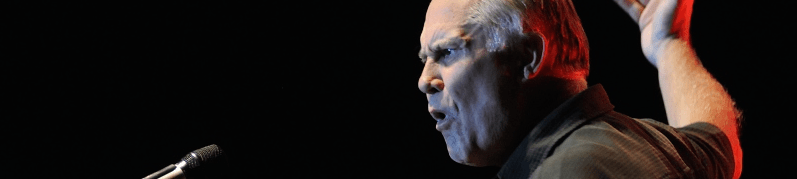
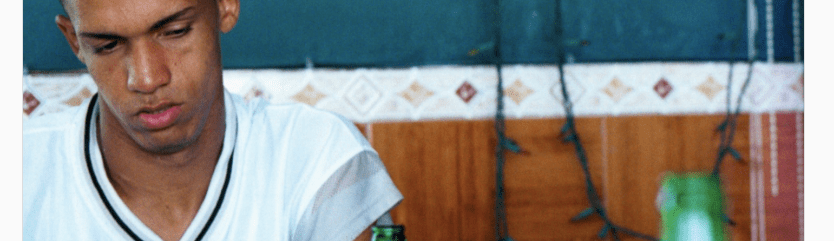
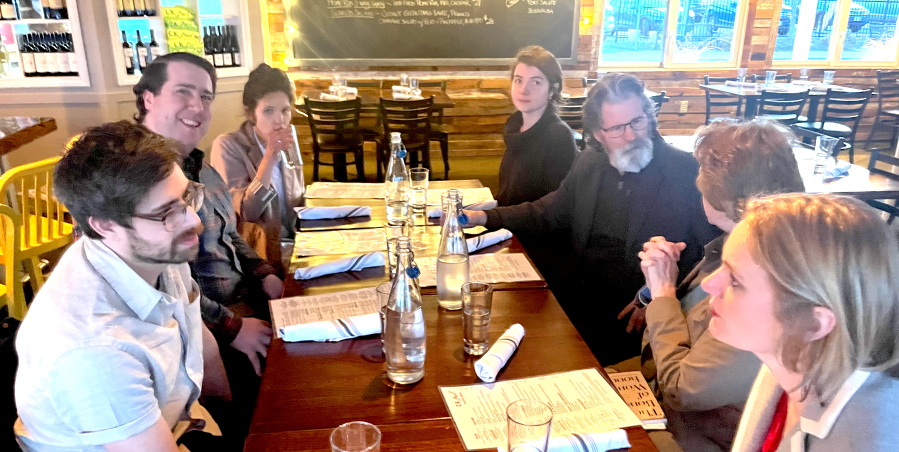
Pic from our dinner with Andre: Gordon writer/profs Bryan Parys, John Mirisola, Sophie Wetzig, Michaela Greco, Andre Dubus III, Andrea Frankwitz, Kerilyn Harkaway-Krieger

Introduction – to Micheal O’Siadhail

We first met the poet Micheal O’Siadhail at Gordon in 1997, at the college’s production of Dancing at Lughnasa—thanks to philosophy professor and expert whistler Grady Spires.

I have a program here that proves that date: Micheal is specially thanked herein.

I should say, “We met the excellent poet Micheal O’Siadhail,” though, forsooth, I didn’t know any of his poems then. We knew him first as a dialect coach pressed into service to help us pronounce the play properly. But (to quote the opening line):

When I cast my mind back toward that summer of 1997, different kinds of memories of Micheal offer themselves to me.

Brian Friel, the excellent playwright of that script was a great friend of Micheal’s—two admirers of the other’s art—and both lovers of the 2B pencil, as it happens. (Some of you may not know their work, yet, but you already share their loyalty to the soft lead-and-clay of the 2B.)

They were friends, Micheal and Brian Friel. I could say, “Of course, they were friends”—but that’s a bit pushy, a bit too easy.

Which Micheal’s poems exactly aren’t.

They’re not easy, as in facile. Not “easy” as Richard Wilbur uses the word in a poem to his young daughter who, while typing, “…pauses / as if to reject my thought and its easy figure.”

And Micheal’s poems are not easy formally, with their stalwart meters and jazzing rhythms and believable rhymes, though the poet’s skill with these elements orchestrates them, harmonizes them, and the language fall easily, pleasurably on the ear. Here is Ars est Kelare Artem — Micheal’s art is to hide the art, not easy at all to do.

His poems—what can I compare them to? Today what comes to mind is fine watches: I’ve been lately enjoying videos of these beautiful, intricate, reliable-and-useful engineering marvels, Rolexes, Patuk Phillipes, others, being restored—admiring their complex inter-relying parts, the jewels, all coordinating in a lovely portable shape that delivers the beauty of the exact time with our easy turn of a wrist.   

An easy figure, but that’s as close as I can come.

Hearing these marvels of his read aloud, as we first did in 2014 with his Collected Poems, or again in 2017 with One Crimson Thread, we will marvel at how the turns of line and phrase deliver the beauty of exactness to our ear and, yes—allow it—to our hearts. When Micheal reads to us, “A stillness greatens, in which / the whole house seems to be thinking” (Wilbur again). Twice before in Jenks 237, from front-row center to the second mezzanine, the stillness greatened, and greatened again, and the whole house seemed to be thinking.

Remarkable and rare is the experience—and the poet who gesceaps it. 

I don’t need to tell you he’s published 17 books of poetry and won many prestigious prizes for them.

You’ll know that soon enough after I welcome to your house this afternoon: the excellent Micheal O’Siadhail.

Festival Introduction – to Kwame Dawes

Kwame Dawes keeps busy. He’s got irons in the fire.

Literal irons—?

No; you and he are good with metaphor: more on that anon.

Kwame is firing so many irons at any given time he might could be a farrier, fettling bright, battering sandals. Some examples of this:

-the Founder of Calabash International Literary Festival…seeking to transform the literary arts in the Caribbean by being the region’s best-managed producer of workshops, etc.—Kwame Dawes.

-the Founder of The African Poetry Book Fund…developing and publishing the poetic arts of Africa through programs and collaborations—Kwame Dawes.        

-the editor of American Life in Poetry…finding and publishing poetry that speaks to various aspects of American existence—Kwame Dawes.

Maybe Kwame’s are actually clothing irons, the old-fashioned sad irons you’d heat in the fire—

Well, here, then, are some of those:

Kwame is editor of Prairie Schooner, AND founder of the South Carolina Poetry Initiative, AND creator of the project “Hope: Living and Loving with HIV in Jamaica,” AND poetry professor at two universities…

Goodness!—With all this, you won’t be surprised that Kwame was recently appointed the Patron Saint of Ironers-in-the-Fire—taking over for Leonardo de Vinci.

And, of course, he keeps writing poems.

When you go online for poetry, you will likely see his face, a kind face, one whiche betokeneth his character.

This “irons in the fire”—isn’t really a metaphor, is it? More a figure of speech now, lifted from the common places of our lives, our lives full of particulars. “It is only,” he says, “in the mastering of the particular and the parochial that a sophisticated universalism can be achieved.” This masterful use of the particular is one of the things we admire about his poetry—

—what he does, for example, with pieces of scrubbed clothing hung out to dry, as in these last several couplets from “Ode to the Clothesline”

…taut lines, propped by poles
with nails for a hook, above

the startling green of grass and hedge,
the barefaced concrete steps,

the sky, inscrutable as a wall;
this is what one carries as a kind

of sweetness—the labor of brown hands
elbow-deep in suds, the rituals

of cleansing, the humility of a darning
or a frayed crotch, the dignity

of cleanliness, the democracy of truth,
the way we lived our lives in the open.

We savor the modest, apt description—of a startling green, a barefaced concrete, a sky inscrutable as a wall, and then that finish, where real laundry lifts into something universal and valuable.

This is uncoding landscapes (and histories and epiphanies) by things founded clean on their own shapes.   

And this is one of the many pleasures and skills and marks of his work. I’ve read lots of it recently. Ilya Kaminsky, festival friend, says, “Why read Kwame Dawes? Because you cannot stop.” Exactly.

I know this too-long & too-brief intro has run a tad cheeky: It’s because I just can’t match the admiration I feel for him—his commitments, his rigor, his abundance, his joy-bringing. Even so, Kwame, I take heart from your remarking that “We are reverential by our noise and by our silence.” I bring you both.

Kwame Dawes is the author of novels, anthologies, nonfiction, and plays—along with 22 poetry collections—the most recent being Nebraska. Last summer he was named a finalist for the Neustadt International Prize for Literature.

Kwame, it is our great honor to have you address our festival today—in a craft talk entitled News from the Middle Way. Welcome, Kwame Dawes.

Festival Introduction – to Patricia Smith

In certain sessions, in certain chambers this week, what was heard – from certain stages, from certain specific rostrums, from podiums therein – what was spoken – out from prosceniums, what was finally heard, spoken—

Listen for the voices you don’t hear, our poet-at-large adjures – urges her own students. Write those unheard voices.

And she shows them – she listens-them how. And those listenings surely become her.

This week in 5 performances, at 4 high schools, to 3 thousand students, over 2 days, our 1 poet-at-large (even-larger than that) loosed mute voices into ear-ful auditoriums of students in this our Palm Beach Country. [sic]

And we – we, down in our all-unprepared seats – numbered seats and comfortable – what we finally – who we finally heard:

Child of – 6th-grade-children of lost mothers—
mothers – of once-sons, was-daughters—
daughters – throats crammed full of rivers—
other mouths now drained of names.

Say the teachers-of-Palm-Beach: Our students have been hit hard by this stuff. They’ve lost—. You can’t know—. These poems—.

There amongst them, sitting in a soft seat, legs languidly crossed, listening, listening to her, to them – how can I not rise to my feet?—

Because – upright.
Because – hear the X’s kissing as they cross.
Because – again – the chamber-mouth is empty.
                    And there’s my son. My son.

Would that no one dast speak such words.

I’m saying weakly what’s been said well in untold reviews, releases, citations: from Kingsley Tufts, Lenore Marshall, LA Times, National Poetry Series: Do we all attend and mark this poet.

And Jenelle, too, (she, student, who read all seven of Our Poet’s books to prepare for her fine memorized introduction before her peers) twice today affectingly said, “By being a four times National Poetry Slam champion, she gives indelible public voice to the many too-long silenced.”

Yes, Jenelle. I wish I were introducing you to reprise.

But it’s me, so, more plainly now: Our poet-at-large, and our reader tonight, hails from Chicago. She teaches at the College of Staten Island, where she was recently made a distinguished professor of poetry. Her first poetry collection, Life According to Motown, appeared in 1991; her fifth, Blood Dazzler, was a finalist for the National Book award; her seventh, Incendiary Art, was a finalist for the Pulitzer Prize. Miles, Susan and Blaise sagely invited her to be our 14th poet-in-the-schools; you have alertly come to hear her tonight.

Darlings, any jazz could be ours, and tonight her jazz is. Please join me in welcoming back to our stage – Patricia Smith.

Delivered at Patricia’s 2020 Palm Beach Poetry Festival reading in the Crest Theatre. During the festival, impeachment hearings were going on in Washington, D.C.

Festival Introduction – to Tyehimba Jess

This is a poet’s introduction, not a news story, but it’s got a lede, and I don’t want to bury it. The lede is this: that actions in our Florida state capital—certain capital offenses, chewed, swallowed and digested—have rippled their way to the poems that Our Reader Tonight, our poet-at-large, brought to three thousand students in five sessions over the last two days at high schools near here.

Just yesterday morning, our poet reminded auditorium-fulls about blackface, opening for the students on a big screen an ancient primer on the technique of blacking up—the burning of corks, the grinding-of-them into powder, the adding-to-them of petroleum jelly. And the application onto the skin… “So easy for gentlemen, and ladies, too.”

Then this morning at breakfast our poet read about this state’s secretary in the New York Times.

The Times, which aren’t a changin’, not enough.

Even before the object lesson, we knew: Our man’s poems are news that stays. For seven years he was devoted to the daily work of recovering personal histories from previous centuries, histories that resonate personally now—for him, and for us; for readers of The Times. What he made from them was Olio, a chronicling in poetry—part performance, part blueprint, part eavesdrop, part chant—in new forms that first engage the reader’s volition, and then step out from the sewn sections into volumes that stand. And deliver.

To encounter these poems is to remember that their speakers—Blind Boone, Box Brown, the McKoy sisters, Edmonia Lewis—each of them troubled this actual air with larynx and embouchure, with sound waves that are rippling out yet, diminished but factual, toward Ultima Thule—and that the sensibility, the instrument that catches – and renders – and returns them to us must be very fine, indeed.

Indeed, it is.

And prescient, too.

Tyehimba Jess is a native of Detroit who lives and teaches now in New York City. His first book, leadbelly, won the National Poetry Series. Olio, his second collection, won the Pulitzer Prize.

It’s with great pleasure and gratitude, Tyehimba, that we welcome you to our stage tonight.

-Delivered in January at the 2019 Palm Beach Poetry Festival. Tyehimba was scintillating and warm & welcoming to students, festival goers, and to me.

Festival Introduction – to Aja Monet and Elizabeth Acevedo

A highlight from this festival is an event that only I and Dr. Blaise Allen get to witness—which is when, in sequence, two poets step to a lone mic in front of a thousand sullen students—and read, and perform.

I could have said, “perform magic,” seeing as how these poets can turn students from timid rabbits into rabid tigers.

—or maybe said “perform surgery,” on account of how these two stand up to stimulate the internal organs of empathy and recognition and resolve.

Is it too soon in my intro for all this?—to say these two poets perform a thousand acts of justice and mercy and salubrious upbraiding—in high schools?

Well, that is what they do—to those “thousand sullen students.”
They perform, they perféct, they deliver, they detonate certain time lapse detonations.

They make, of those students, a thousand splendid suns.

I said “two poets.” It’s true I could have said “raconteurs, rhapsodists, scops, bards, balladeers.” I say again: two poets, who assess from the page, and arrest from the stage, with throat & tongue, and timbre & timing & gesture—in form and moving. How express and admirable.

I say móre: these just poets justice; keep grace—thát keeps all their sass and sauce.

I said we “get to witness.” I could have said we “get in the midst of”—“get mixed up in”—because to engage their poetry with eyes & ears is to engage it with skin, and follicle, and capillary. Even tear duct.

As I have seen, and you will shortly know.

Please welcome Aja Monet and Elizabeth Acevedo to our stage.

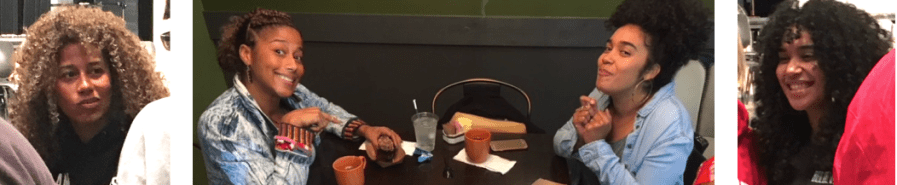
-Delivered at the 2018 Palm Beach Poetry Festival. Aja Monet (above left; her poem “The First Time” is here) and Elizabeth Acevedo (above right; her poem “Hair” is here), brought brilliance to schools and the festival stage.

Festival Introduction – to the Mayhem Poets

For the last couple of days, while the poets in Old School Square were workshopping and craft-talking, our two guests tonight were word-cajoling in high schools around Palm Beach County.

This is proper & fitting, because for the last half-score years, while we-all were on vocation, so were they—

vocationing—verbally, vocally, day-in and day-out, in theatres and gyms like this one all around the world.

And yesterday, while our new president was trumpeting in the streets, children in those same schools were dying – with laughter, and holding their breath, and handling words at once true and kind—

kind because vulnerable, and therefore full of power and authority.

Watching our guests from a fold-down seat didn’t just make me want to be them—
to imp my wing on their wit and talent and savoir faire

watching them made me mindful of,
grateful for those first permissions we all felt to love a poem—
to “belovéd a poem,” by Simic, or Perillo, or Roethke—and hear that voice that spoke up from the page, to us.

And for.

That’s what our guests are always up to, gig-after-gig,
voicing live from the stage what is scary, and scandalous, and scanned,
and granting permission to folks-young-as-we-were to speak—
and that in poems.

Here’s a little video of a student slamming a poem for them after one of their shows…
(Kidding—we have no screen here. But it happened.)

Legit now: Mason, Scott, hanging with you has been a highlight for me this week.

Year after year, you
bring the Mayhem Poets, you
get mayhem, poets.

Please welcome them to our stage.

-Delivered at the 2017 Palm Beach Poetry Festival. Scott Raven and Mason Granger (l to r), two of The Mayhem Poets, regaled a couple thousand students with poems like these.

Festival Introduction – to Poet Marc Kelly Smith

Robert Pinsky says that poems are musical scores, to be performed by the instrument of the body. The lungs, ribcage, larynx, the tricky tongue and shaping mouth (some of you heard Kevin Young mention embouchure), the resonators of skull and nasal passages, upheld and amplified by the diaphragm—all these concert together (with pitch, posture, and pulse) to release a poem’s music—

And I haven’t mentioned the face, its members express and admirable as a portable Mummenschanz.

Well. Our guests tonight would seem to agree.

What do you need to know about them? Little to nothing, I expect.

Should you know that Marc Kelly Smith invented the poetry slam at a Chicago bar in 1984, and that he’s been doing it nonstop ever since—a three hour set at the Green Mill every Sunday night, the longest running show in Chicago and poetry slam history?

Does it matter to you that, though there are manifold films/CDs/books about slam, Marc has kept on resisting the co-opters and franchisers with a sweet old-fashioned belief that poetry SLAMS BEST on the fringes, in real bars, in real neighborhoods, in gatherings of the original and inexpert?

Does it make a difference to you that, over the last two days, our man engaged a couple thousand high school students, embodying how a shy person can trust and venture LANGUAGE—and that he got all of them performing, and dozens of them up on their feet, mics into their hands, their voices fat in surround sound?

Should you be forewarned he doesn’t think of himself as a slam poet?

—or that, even so, he’s complained publicly about effete poems feebling forth from page or stage, so that this week our chevalier, Miles Coon, may have greeted him with, “Why am I bringing you to this festival?” (But, of course, he did—a tribute to both.)

—or, finally, that after the DuhamelLuxShapiro reading on Tuesday, this man, who seems never to need a printed page to bear The News, exclaimed, with his slightly Chicago vowels, “That was fantastic. So good, that if I’da heard dem when I was young I wouldn’ta had to invent slam poetry!”

I don’t know if that stuff matters to you now as he approaches the stage. And truth is, you’d get it all for yourself; so this intro is just me glossing the goods beforehand.

Here then, more chastely: Following on thousands of performances in nightclubs, concert halls, libraries, universities in venues worldwide, he brings his malleable, effectual, appealing self to our precincts tonight.

Here is all you need to know.

Welcome, Slampapi—Marc Kelly Smith.

-Delivered at the 2016 Palm Beach Poetry Festival.

Festival Introduction – to Poet Dominique Christina

Having learned a lesson earlier, I hope to carry fewer coals to Newcastle in this introduction of the poet Dominique Christina.

The catalytic Dominique Christina, I might effuse.

But you will shortly write your own superlatives.
What, then, will suffice for me here?
A few instances, perhaps:

—OK, for instance, Dominique Christina didn’t begin, hadn’t thought of performing a poem until six-or-so years ago. She was writing poems—her first, best love. Then some-smart-one said, “Dominique, you should stand up and say these things.”

—for instance, what was she doing then but teaching English, to students with certain troubles who, but for the grace of Dom, were headed down and out, maybe away, maybe for good. A dozen years’ worth of alleged incorrigibles have leapt to her high bar, looked for her kindly lash, and got her good graces in the classroom.

—for instance, when regarding a stadium-full of high schoolers, like she did this week, she will not stir the sanctioned myths of sweetness and light, will not denigrate or prevaricate thereby. She will cut what matters, cut quickly to your matter. Hear me: Were you there, you would watch 800 embodied aspirants writhe, and recognize, and rise to their feet at her accurate beck and call.

—and for instance, you would watch them come boldly forward to meet their provocateur, to touch and hug her, and be hugged hard in return, and to take selfies—yes—

—and (for instance) what MAKES them crowd into the frame with this secret sharer, this slinger of dark-and-bright, is nothing like what compels a pic with Beyonce or Bruno. What is it that compels? It is what she tells them in words and non-words: “You are magnificent. The world needs you. And you gotta SHARE you.” For that, we all get in line.

Jamnasium, I tell you (for final instance) that nobody I know of has better intuition, quicker reflex, agiler access to what must inflect a poem’s passage. Or to what will bring the cowed student to her feet, and then to the stage (by a reliable tug on the wrist, and arm round the shoulder blades), there to speak her own truths.

These rarities the slam world knows—she’s a champion five times over—

—and tonight, we will relish our own instance of this coalescing—of grace and impulse, of verve and conviction, of pith and moment.

Dominique, come now and read us your scripture.

-Delivered at the 2016 Palm Beach Poetry Festival. Dominique regaled 2600 students with this poem (“The Period Poem“), among others. You should click to it.

Crooked Rose My Youth – a Paean

I took a survey of British lit course in my first college term. We started at the front of our fat text, and over the weeks an exaltation of poems went winging past me and my fallow acre.

Two years—hear me, now—two real years later, while memorizing (because I needed to own it) “Lovers’ Infiniteness,” some insistent thumps began in my deep brain, my heart’s core. But they were not thumps of Donne.

Oh no, I thought. Those accents must be from a poem I read back in Survey. I’ll never trace them.

Still, I retrieved that old tome and, turning to Caedmon, put my ear to the page and started forward—from the strong stresses, forward through the wide centuries, into the accentual-syllabics (“and she me caught in her arms, long and small”)—with variations (here was “sighs, tears, and oaths, and letters”—that perfect double and)—into the strict countings (“to load and bless with fruit the vines”)—and the sprung rhythms (“that year of now done darkness I wretch”)—forward toward the new century—(“he, she, all of them, aye”)—its sonic mimeses (“Quick, boys!—an ecstasy of fumbling”)—beginning to despair now—

And then, there they were, sounding, sounding up from the print:

The fórce that thróugh the gréen fúse dríves the flówer

Blunt morphemes to me the first time, at 19—mad hammers, lacking all sense:

Dríves mý gréen áge

Beat-beat-beat-beat in me.
Break, break, break on my stone ears.
And then that thunderstruck finish:

And I am dumb to tell the lover’s tomb
How at my sheet goes the same crooked worm.

Years later, you see, and even more years, that Welsh silversmith is still
beating and beating at my intractable metal.
__

[The force that through the green fuse drives the flower]
Dylan Thomas

The force that through the green fuse drives the flower
Drives my green age; that blasts the roots of trees
Is my destroyer.
And I am dumb to tell the crooked rose
My youth is bent by the same wintry fever.

The force that drives the water through the rocks
Drives my red blood; that dries the mouthing streams
Turns mine to wax.
And I am dumb to mouth unto my veins
How at the mountain spring the same mouth sucks.

The hand that whirls the water in the pool
Stirs the quicksand; that ropes the blowing wind
Hauls my shroud sail.
And I am dumb to tell the hanging man
How of my clay is made the hangman’s lime.

The lips of time leech to the fountain head;
Love drips and gathers, but the fallen blood
Shall calm her sores.
And I am dumb to tell a weather’s wind
How time has ticked a heaven round the stars.

And I am dumb to tell the lover’s tomb
How at my sheet goes the same crooked worm.

PWS was the professor of record.

o'keefe flower8

Tribute – The Greatness of Sourber (in appreciation of our teachers)

My grade school classmate Sourber was the Evel Knievil of bicycles. I once saw Sourber ride a bike straight up a tree trunk—5 or 6 feet up before he fell back in a tangle of spokes and limbs. The bike had no brakes—which he probably knew. He just lay there on his back, laughing.

Sourber was the Franco Harris of sack-the-jack. I once saw Sourber shake my tackle, and three or four more, and juke and fake until finally someone caught onto his shirt, and we began to pile on, leaping onto him like salmon, one after another as Sourber staggered downfield with five defenders on his back. Finally Cheryl Groah dove and tripped him up. As the pile disentangled itself, Geoff Hauck shouted, “Jeepers creeps, it takes the whole doggone army to bring Sourber down!”—which was one of the most memorable things I ever heard anyone say. And Sourber lay on his back, laughing and laughing.

But Sourber’s greatest moment of those young years came as a result of Eichenlaub. Mr. Eichenlaub, reading teacher. Eichenlaub was really his name. And that spring he had it even tougher than his name—because he was student teaching under Mrs. Crotchety Frownface. Mrs. Frownface’s class was living death: book reports, SRA, and a general sense of mummification. But that spring, a small miracle happened: Mrs. Frownface took time off from teaching (maybe to get a mouth lift), and that meant Mr. Eichenlaub took over.

I didn’t know much about teaching, but it seemed to me that Mr. Eichenlaub had the right idea about how to do things. The deal was, we would work very hard and very attentively for a couple days and get a little ahead of schedule. Then the time we had saved up could be spent—on kickball.

Kickball! When we’d scrimped enough minutes, Mr. Eichenlaub would close his book and say, “All right, this is it. You know what to do. Let’s go.”

And we were so happy—but we were so quiet as we sneaked out of the school, the entire quiet sneaky class sneaking right out of school with the teacher who was sneaking out with us—

—out to the ball diamond. And then with model efficiency we divided into teams, and with model cooperation we assigned lineups and positions, and with model application we applied ourselves to our favorite project, the ancient game of kickball.

Which brings me back to Sourber, and the greatest moment of all.

The sun was out, big and bossy, I was standing near the dirt spot that meant second base, and Mr. Eichenlaub was on the mound—all-time pitcher. Then Sourber came up.

Sourber was the kind of kid that, whenever he was up, whatever team you were on, you felt something like hope or glee in your throat. There was something so pure and exultant about him as he prepared his body for the explosion—it made you hold your breath. Sourber called for a bouncer (as opposed to the roller), and Mr. Eichenlaub served up his trademark bouncing pitch.

The rubber KUNG! of the well-driven ball thrilled us as Sourber’s great boot blasted far over Netscher’s head in left—and it was pandemonium. Sourber was chugging around second before Netscher nabbed the ball, and flung it to Born, and Born zipped it to Szymanski, we were shrieking—and there!—there was Eichenlaub in shallow left field, waving his arms as Sourber ate up turf toward third—

Sourber rounded the base as Szymanksi relayed the ball to Eichenlaub who spun around quick—and then I knew that something momentous was about to happen—Sourber streaking toward home, kids leaping and hollering, and Eichenlaub with the ball steamed toward the infield, reared back and chunked an absolute rocket, the ball actually changed shape, changed into a red rubber missile that howled through the air, an adult throw no doubt about it, straight as a ruler and gunned at the intersection of Sourber and home—and Sourber, young as he was, his black hair flying, sensed it coming with that intuition of great ones, and at full tilt he flung himself into the air, arching his spine backward, the missile screaming at his body—he arched around into a perfect semicircle above the earth, and the red hot missile of Eichenlaub whanged neatly through that semicircle of Sourber and kept going and going, and Sourber cachunged to the ground at the plate, rolling, rolling, safe at home, safe!

It was a miracle. It was the sports miracle of my life. And Eichenlaub, bless him, waded into the hysterical mass of kids and grabbed Sourber up with a great shout, and hoisted him high up, shouting, “That was great! That was great, you’re great, Scott Sourber!” And Sourber was laughing, high in the air there, Sourber was laughing.

There was no doubt about it: Scott Sourber was the Willie Mays of kickball.

And there was also no doubt that Mr. Eichenlaub was the Scott Sourber of teaching.

I was nine years old; I was in fourth grade; I knew greatness when I saw it.

This first week of May is Teacher Appreciation Week. For me, every week is.
I loved (and hope to have learned from) Mr. E’s unguarded praise of Sourber, and of the rest of us. Being seen, being appreciated like that by a someone at the right moment—that can really stay with a fellow.
This piece was written as the closing monologue for a weekly variety show that the Austins and I produced on WEZE radio in 1994/5.

Chariots Chanting

Dear Brian O’Donovan,

Hearing you on BPR today was the last straw; another was on a dark December night in 2016, when my wife and kids and I found ourselves reluctant occupiers of a pew in the UCC church in Gloucester. There were handfuls of battened fisherfamilies evident in the wide, underlit space, all facing in the same direction as the klieg lights’ throw. Up there where a pulpit should have been were singers, and players, reaching down into somewhere, time and again, to retrieve ancient tunes equal in spark and radiance to the dark that was—and that was coming. I mean they were caroling, and chanting, up among the strung pine boughs, behind a huge yule log, and teasing us out, cajoling us to join them. How? With hurdy-gurdy, a new sound to me, and fiddle, as my father called what he played, and wide drums they wielded like cymbals or flashing shields.

And didn’t we find our separate clusters blending into one big one, and our stiff hesitance softening and dissipating away, and our limbs moving in time, unbidden, and then our actual voices singing along, and even—who’d have believed it?—our bodies, old and young equally, deigning to lift from the pews, and moving out into the aisles, all of us, every single one, to join hands, and circulate the empty seats, the creaking floor drowned by the stomp and tickle of the music we made, and by the dance, wherever we may be, which was in a dark, bright Gloucester church on a night no one expected would hold such a thing, no one who was me, anyway.

The other straw was on a recent Saturday afternoon by the sea in Marblehead, my kids and me in the car on an early March day of our long withdrawing, listening, after climbing a rocky hill, to someone on your show who you’d recorded earlier, back from a tour or about to tour again, one of many such persons whose song that day, in whatever voice, male or female, with whichever instrument, sparked up like a fire against the strange darkness and distance we knew were coming, and have come—waiting in the rollicking air until the song ended, and only then turning the key, and driving on into the day.

I hope you’ll give 30 seconds to the attached audio clip [below] from that old December night; you’ll hear the stomp and tickle you yourself are so familiar with, and our voices, chasing our eager leader, following her with hope and heart into the long passage through night.

Brian O’Donovan is the host of A Celtic Sojourn, Saturday afternoons on WGBH radio.

Introduction – to Bryan Parys and “Wake, Sleeper”

Welcome to this wonderful, quite singular event,
a concert of sight and sound and taste – conspiring and consorting in this grand old magical Ware Theatre, now the Cabot—

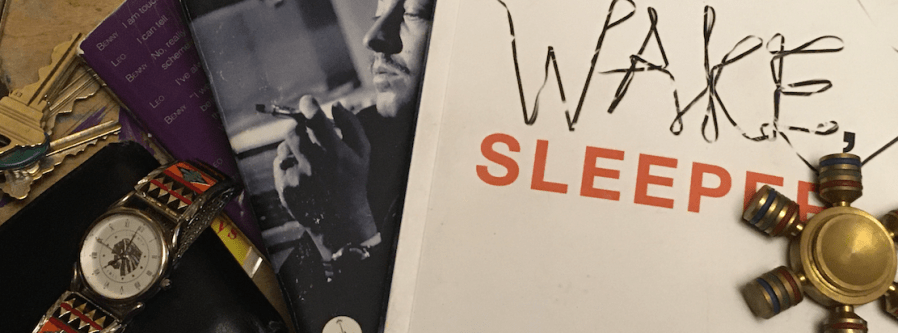
All remarking and rising from the main attraction, which is the release and the reading from Wake, Sleeper by, yes, the author of all this artful synesthesia – Bryan Parys.

A man somehow loved by friend and foe alike…

I’m one of the friends, and former professor, and now current student of all of our readers tonight.

First, join me in appreciating tonight’s conspirators:

We’ve been loving the music of Cal Joss,
and of Aisha Burns,
and, soon, of Natalie Parys—

while savoring the art installations by Marika Whitaker,
and Maia Mattson,
and K. Lee Mock—

and while admiring the prints & posters of Jon Misarski,
and Grant Hanna—
that have beautifully inclined us toward this evening.

Shortly, we’ll relish the poetry of Pete Murdoch, and Jonathan Bennett Bonilla—and whoever else Jon might evoke or evince.

There are more people to be mentioned and thanked, but I’ll let Bryan get on with that.

Bryan Parys first showed up in my world a-couple-maybe-a-dozen-years back.

He seemed not to know quite what to do at first, and for a while he cast about, like a noiseless, patient spider.

Maybe not, exactly—but at length his intellect fastened on to writing, and there he began to spin, to see what might come of it.

Poems came of it, plays came of it—each and all with his evidencing style and appreciable appreciation of what is true,
the worth to be found in the serviceable phenomena of our everyday world.

Shortly thereafter in an office full of Norm Jones and me, he read aloud an essay he’d spun up about his childhood game of hyssop tag.
Didn’t Jones and I laugh and murmur?—suspended by his blend of humor and candor and discovery.

From that office, thence to UNH, on a scholarship, to study (and then to teach, winningly) nonfiction, the lyrical essay, and then, happily, back to Gordon classrooms again, this time to buffet and abrade and improve students who (like him not so long ago) don’t know what’s at stake, what’s worthy the reaching for, or how to reach for it.

In classrooms, I say, and in casual conversations, in the pages of Stillpoint he shows us just that—takes what is offered, what is available, and illumines it. His column, sporks, is the first illuminated manuscript turned to by 9 out of 10 Stillpoint readers, and for good reason.

For the last eight years he’s been essaying to discover something, and something worth saying, about his own available life—its beginnings in loss, its assemblings in gymnasiums, its arrival at a tentative equilibrium & a definite wakefulness.

Tonight we’ll hear some of his essaying-in-prose.

We’re enriched to know him, we’re enlarged to read him, we’re pleased to welcome him—and to recommend his terrific, new book

The man of this and every hour: Bryan Parys.

No one slept at this March 31, 2016 event—part reading, part concert, part gallery exhibition, part art bazaar. Part magic trick: do that again.

bp front of cabot smaller

Wake, Sleeper is a brave, irreverent, funny and stunningly generous exploration of faith and resistance to it, of identity, of grief, of the joy of intellectual and spiritual inquiry.”
-MEREDITH HALL, author of the best-selling memoir Without a Map

Notes – on the Holy Theatre

Your favorite spot on earth is the lobby of the National Theatre in London. Partly because you have to work so hard to get there. Partly, also, because of the lives you’ve lived there, which you still carry in your body. And partly because of the most assured overthrow that awaits you each time you finish your white coffee and head toward the ripple seats.

* * *

One winter, for four months, a play of yours ran at a dingy dinner theatre up in Georgetown, Mass. You’d directed it, too, and built the set, all of it. On 45 weekend evenings you climbed into the loft behind the tables and ran lights and sound, while patrons ate thawed chicken parmesan. Sitting up there watching the crowd, you rode their laughter to a kind of pinnacle. Have you been happier? Give me my sin again.

* * *

For years you’ve been herding students toward theatres, the National, and the Traverse and the Pleasance—for plays and musicals, but also for pantos and foolery, for marathons and acts without words. The lights, the urgency onstage reflect off their eyes and their teeth. They grab your arm. Afterward, you all stagger out to a table of spring rolls, to lick wounds.

You take them to these things so they can be flabbergasted, and confused, and confirmed. So they can see what it is we humans care about, and how to care about it not wisely and too well. You take them to be offended. Give us our sin again.

* * *

You attend an Episcopal church. You go there, sometimes, because Andre Dubus, after being hit by a motorist, could manage that, only that. He wheeled to the mass. Sometimes you think of Dubus in your pew, and of theatres. How being at the living theatre can feel like being at a living church. How our faith before the stage is as real and necessary as anyone’s who’d get out of a boat and walk. How we face each other, and agree to believe together.

And when we do, when the show is right, everyone, every single one, is healed of their sniffles and coughs, and we float bodiless and rapt until the script lets us go. Almost a holy edifice, you say. Who are these priests, these prophets? Sarah Kane, I have ears to hear.

-Why not read some pages in Peter Brook’s The Empty Space?

Letter – to the Literary Department at London’s National Theatre

Dear Ms Peters,

I type this with a latte to hand here on one of the National’s high outside balconies. Moments ago the courteous Dominic at the stage door sent me to you through this magical portal.

I’m a teacher and writer, and since 1995 I’ve brought 350 college students from a hamlet north of Boston (USA) here to London to see shows at the NT. Our tally of seen shows exceeds 100. Yesterday we added Angels in America to the list—

—a production we will never quite get over. Neither will forget the opening of The Bacchae, or the final moment of Iphigenia at Aulis. A hundred-hundred moments that lived first for us in the Lyttleton’s ripple seats live in us yet, and have livened how we do theatre, how we teach writing, in our small liberal arts school.

And when we lay over in London on our way to other Europes, we queue early and stay late under your roof. Conversations with Simon Russell Beale, Patrick Marber, Caryl Churhill, Jeremy Irons, Wallace Shawn, Desmond Barrit, Rita Moreno, Michael Frayn, Christopher Hampton, Judi Dench, William Houston, Emily Watson, Anna Chancellor, Iain Mackintosh, even John Gielgud (who came with Dame Judi to see Sir Ian in Lear)—these never leave us, and inspire gratitude still.

We cherish the sweet, savvy tour guides who’ve shown us backstage and front, mentioning the reason for the seat color in the Olivier. We remember jazz on the concert pitch, and the green AstroTurf (as we call it) of Watch This Space, and the bracing shows (with Chiwetel Ejiofor & Andrew Lincoln) in the Lyttelton foyers—

—and the hours we spent kindling with other lovers like us in and around your concrete crucible of lifetimes.

All of this to say: your address is our very favorite on earth, and your commitments have improved our days.

In another year or so I expect to be granted a sabbatical from teaching playwriting and poetry. I have no greater wish than to find my way back to your address, for some shorter or longer period. There is no place I’d rather be.

Could I volunteer whatever I have for any need or purpose of yours? Requiring no pay, only a backstage pass to satisfy Dominic, I could write toward a “Making Of” account, like those on Humble Boy and Bacchae that I give my students. Or perhaps I can assist in useful ways with your growing online archive, a resource I access often. Or sign me up as a tour guide, and pay me nothing to enrich as I’ve been. Do you need a diarist? An assistant to a dramaturg? Someone to make copies or phone calls for the New Work Department, or set out chairs and water for Al Senter-and-guest? Or even a scrivener to reply to oddball offers like this one?

If so, I’m your man.

And it needn’t ding a single budget line, because I’ll still be in the pay of my usual employer, a college that’s seen fit to invest in our annual pilgrimage here to the South Bank.

That’s my hopeful pitch. Now this:

Once, jogging to one of your shows, my billfold leapt unawares from my pocket somewhere between the Cottesloe and the base of the stairs from Waterloo Bridge. I realized the loss at the box office, and retraced my steps in a proper panic and haste. And there it was on the stones, fat with 900 quid, somehow invisible to all but me and bronze Sir Laurence.

Like so much that happens where you are—where I sit now as I type—this little story is imbued with a grace, and is beautiful because it’s inscrutable and undeserved.

Will you keep me and my lucky wallet in mind?

Sincerely, with gratitude,

Mark Wacome Stevick

-This was sent summer 2017. No reply yet.

Remembering – Derek Walcott, 1930-2017

[from an interview conducted by Bryan Parys]

bp: You studied with Derek Walcott in grad school; how much did his tutelage affect your own work?

Mark S: Let me admit here for the good of my soul that I didn’t really know Derek’s work when I applied to Boston University’s graduate creative writing program. Or Robert Pinksy’s either. Just their names, which had appeared over poems I’d seen in Norton’s. I knew a bit of lore about Lowell and Sexton and Plath, and even Starbuck, but I also appreciated that their ghosts weren’t going to help me with my poems (James Merrill notwithstanding). What mattered most to me was that Boston University was only an hour’s train ride from my house. So my pedestrian (or commuter rail) motives were rewarded out of all proportion.

But what did Derek teach me? To rise at 5 and write for hours. To make the beginning of a line as vigorous as its end. To labor not merely for the line or word, but even for the letter. To write longhand. To read aloud both poetry and prose for their training rhythms—Edward Thomas, Hart Crane, Ernest Hemingway… One time Seamus Heaney and Joseph Brodsky came in to argue with Derek about the poems of Thomas Hardy—whose work they all loved and which we all read aloud. These things Derek taught, although they’re not necessarily things I learned. I don’t rise, as he does, at 5 and write for any amount of time. But my work was affected by his tutelage. I became more accountable for each word or phrase in my poems, so they got shorter, denser, better. And Derek liked my poems, which allowed me to believe in them. When he told me to send them out to The New Yorker and The Atlantic, I went ahead and did it. Derek didn’t believe me when I said they hadn’t landed. “Show me the rejection letters.” I showed. “It doesn’t matter. I’d publish them.” So I put that in my pipe and smoked it for a good long time.

He was an extremely alert and agile reader of one’s stuff. Once I brought him a poem which I felt went awry somehow at the end, and when he got to that spot he started saying, “Oh no, no, no, no!”—while I was saying, “I know, I know.” And that’s all we said about it. I was pleased and gratified by our mutual un-enumerated horror. Then there was his most impressive reading moment.

bp: Which was?

MS: You’ve heard this before, and you’ve probably made fun of me for repeating it. But, OK, briefly: once in a sit-down in his office Derek was quietly reading a poem of mine, one that was composed entirely of eleven-syllable lines. On that first reading—the first time through it, mind you—he looked up from the line “and the black lacquer table is peeling,” and said, “Top, I think. Table top is peeling”—thus bringing my errant 10-syllable line into the poem’s overall pattern. I hasten unnecessarily to add that he did this without counting on his fingers, as anyone who hears this anecdote must do.

bp: I remember that story.

MS: I know you do—but it was kind of remarkable. A bit like “The Princess and the Pea” in its way. And now my poem includes a word “written” by a Nobel laureate. It appears unattributed, of course.

-The poem Derek amended is here. Bryan and I did this interview a decade ago. My friendship with Derek warrants an essay I hope to write.

Essaying – Theatre Anglonauts

2016 marks our 21st trip since we launched the UK Theatre course in 1995. We’ve had 345 Anglonauts.

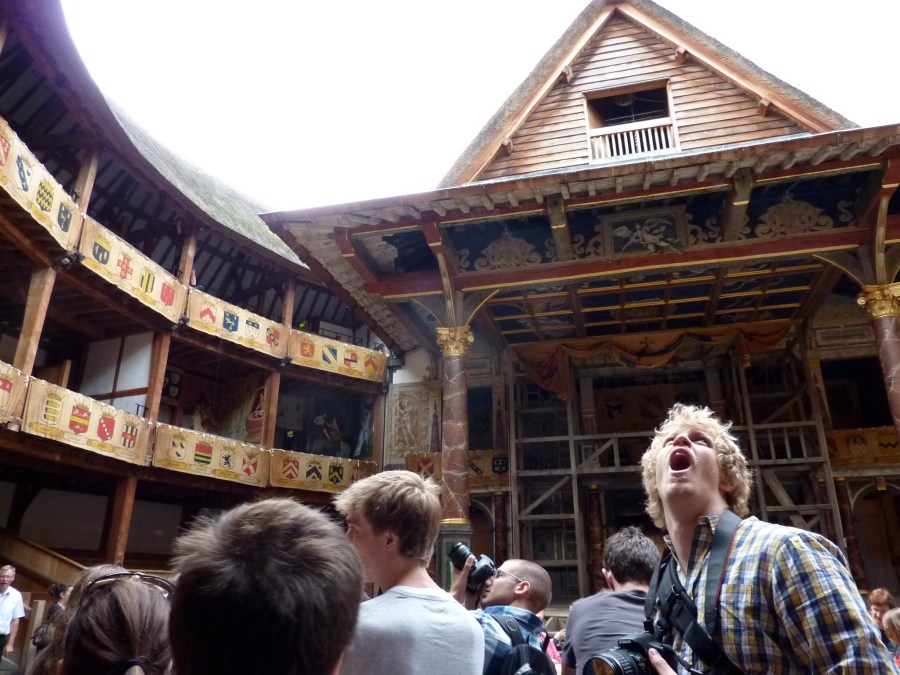
In years of yore, we traveled right after commencement, and our sometimes chilly itinerary included places like Dublin and Galway, and, in England, Bath (with its Royal Crescent and Pulteney Bridge—twin to the Ponte Vecchio in Florence), Stratford-Upon-Avon (home to three very different theatres and to the Bard’s crypt), Oxford (with a cooling pause at the Inklings’ Eagle & Child pub), and Cambridge (there to savor an evensong at King’s College Chapel)—and, always, London. Day trips have taken us to Salisbury (tallest cathedral spire in the UK—at 404 feet) and nearby Stonehenge (big gray stones; little red poppies), to Ely (named for its eels, and home for a decade to Oliver Cromwell), to Coventry (with its massive Graham Sutherland tapestry behind the altar of the 1962 cathedral, itself verging on the ruins of the Nazi-bombed 14th-century cathedral), and, in Ireland, to the Aran Islands, to James Joyce’s tower in Sandycove, to Dublin’s Glasnevin Cemetery (chaste resting place for the 19th century’s greatest English poet, Gerard Manley Hopkins), and to the village of Kinvara, where Dawn and John Sarrouf got engaged and began scheming up Elijah and Esme Sarrouf.

In 2004 we switched to an August trip that included a week in Edinburgh to take advantage of the thousands of theatre, dance, music, spoken word, and nearly unclassifiable performances in the Edinburgh Festival Fringe, the world’s largest arts festival. There we see as many events as we can in one week: Jeff Miller manages three shows a day on most days (when he’s not supine in Princes Street Gardens). In the lee of the Castle of Edinburgh another engagement occurred, Norm and Jean’s, and soon after that spot was memorialized in a painting.

We’ve honed our approach, so we can offer a lot of culture for a little green. Classes occur in the morning, usually with a white coffee, often in one of the several lobbies of London’s Royal National Theatre, or in an atrium at the foot of Arthur’s Seat in Edinburgh. Students live in flats-with-kitchens in the hearts of these two capitols, and the afternoons are free for museum-going, Beefeater-watching, punting, shopping, picnicking—all of which are endeavored. Evenings find us in the front rows of the UK’s best theatres, in the living presence of the English-speaking world’s great actors—Judi Dench and Ian McKellen, Mark Rylance and Maggie Smith, Simon Russell Beale and Fiona Shaw, Helen Mirren and Michael Gambon—and some terrific young actors, too, whose performances mark them as tomorrow’s stars.

John Sarrouf adds: “We’ve written poems in the graveyard on the Avon-thru-Stratford; quaffed with casts at the Dirty Duck; sketched the courtyards of Kenilworth and Warwick Castles; interviewed WWII vets at Lewis’ house, The Kilns; candle dipped at Tintern Abbey; haunted open air markets in Portobello, Cornwall and Penzance; twirled late night pasta Bolognese at Denise’s Restaurant. We were in a West End theatre when John Gielgud died, and the lights were dimmed, and actors came on stage after the show to tell stories of his work and influence. We sat next to Tom Stoppard for the first preview of the revival of The Real Thing, which went on to win the Olivier and the Tony that year. We saw the Shape of Things, and History Boys, and Closer, and The Designated Mourner, and August: Osage County before they became movies.”

The two-week trip is a crucible of culture and conversation, one that inspires the leaders for another year of making art, and impresses some life memories into the still-soft sensibilities of the students.

-On this trip you can do an independent study in creative writing with me. It’s called “Writing the City,” and you’ll use London’s & Edinburgh’s cultural and artistic offerings as material for original compositions of poetry, fiction and creative nonfiction.
See Molly Elias’s work at https://cleareyesfullpassport.wordpress.com/.

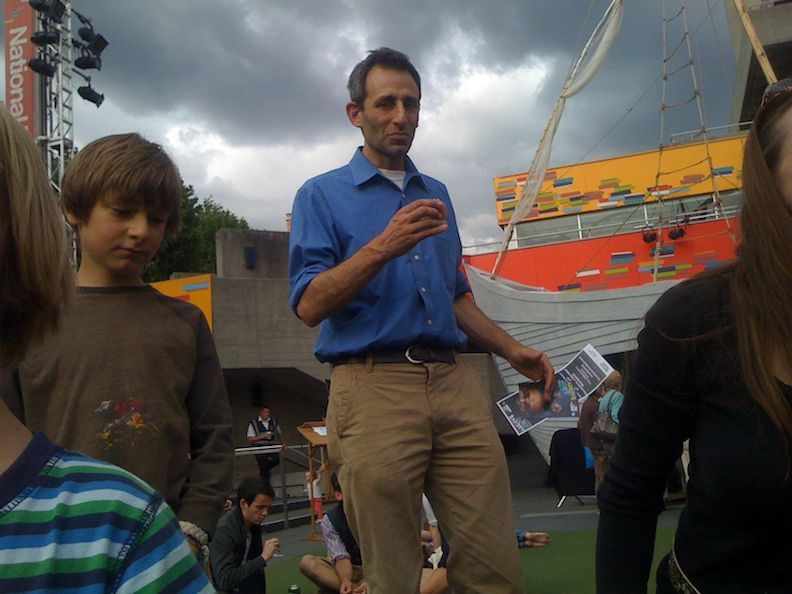
sarroufs at national.2