Introduction – to Andre Dubus III

Andre Dubus III caught in our consciousness in 1999 or 2000. It was that novel of his, with the enviable title, House of Sand and Fog. Enviable, evocative.

We ourselves weren’t big into Oprah, who herself was big into his book (but I think that was after we’d already read it—we were ahead of the book clubs, just like Vadim Perelman, who tapped our guest for the rights to make it his first film, starring (why not admit?) one of our acting heroes, Sir Ben –
Kingsley).

But that was 2003, so let me sidle back to ’99 when we first turned over that savor-able title page.

What we remember is the Iranian colonel on the road crew, in the broad heat, with his trash bag and picker, his remote dignity under the squalid duress of his boss and sidecrew, unfolding his sack lunch of tea and radishes beneath a shade tree—Behrani, so courteous and unfathomable to the others…

This scene we remember rhyming with a work scene from another book: a kid/man digging trenches in the booming sun, Louisiana, his pick axe and shovel, and tough men with tougher hands, forgoing his lunch of sugar and lemons, sleeping it in the shade of a shed—his youthful prescience and resolve, so remarkable in his way…

—that scene written by Andre pére, father of our reader tonight, his book out the same year as his son’s, Meditations from a Movable Chair, 1999.

There must be a fire inside you to match the one outdoors, says the colonel-crewman.

I tasted a very small piece of despair, says the man/kid.

Twain scenes, of harsh senses and sensibility, of labor and lunchability, that make me wonder about this Dubus family craft – of writing: did the habit of art get handed down, passed along? It seems so. But how so? We may read about that in Townie, if we wish, which begins with another habit, too, the habit of pain, father and son running hilly, looping miles together, years before these two books I’ve mentioned.

—these books, son’s and father’s, that were passed along to me by our writer-saint, Lori Ambacher, fictionist, essayist, poet, friend of the Dubuses, too, who somehow ended up in Andre-father’s writers workshop. (If there was too much light in the room, it might have been Lori herself.) Lori who taught here at Gordon for twenty years, literature, conversating, creative writing. Lori whom we cherish and honor with this reading and this year’s Writers Series. Grove, Lori’s longtime partner, we’re especially glad to greet you tonight.

I think this introduction, now nearly at its end, has been more for Andre and me than for the rest of us here—I apologize for that.

But, really, how much introduction is needed? Nine books, three kids, one love-of-his-life, all jumbling around in a house in nearby Newbury that he built with hands hardened by #2 lead pencils.

Thank you, Mass Cultural Council; thank you, Lori Ambacher; and thank you, Andre—or as Lori called you—ladies and gentlemen, please join me in welcoming “Andre Three.”

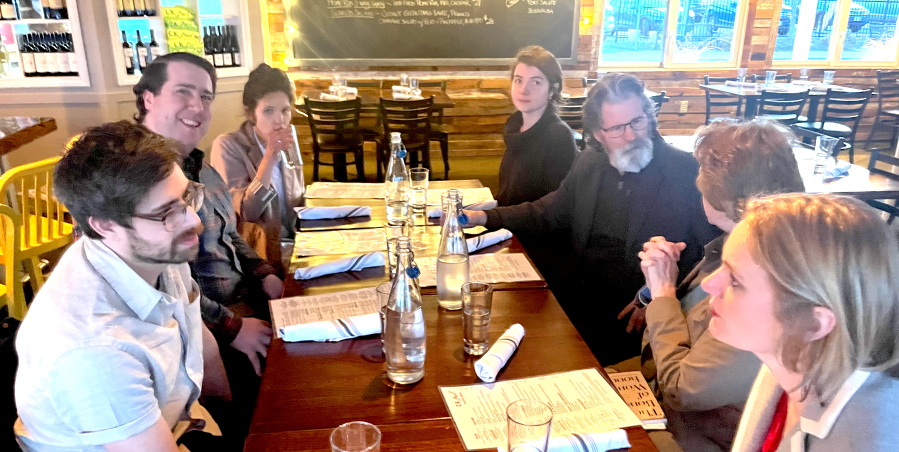
Pic from our dinner with Andre: Gordon writer/profs Bryan Parys, John Mirisola, Sophie Wetzig, Michaela Greco, Andre Dubus III, Andrea Frankwitz, Kerilyn Harkaway-Krieger

Introduction – to Micheal O’Siadhail

We first met the poet Micheal O’Siadhail at Gordon in 1997, at the college’s production of Dancing at Lughnasa—thanks to philosophy professor and expert whistler Grady Spires.

I have a program here that proves that date: Micheal is specially thanked herein.

I should say, “We met the excellent poet Micheal O’Siadhail,” though, forsooth, I didn’t know any of his poems then. We knew him first as a dialect coach pressed into service to help us pronounce the play properly. But (to quote the opening line):

When I cast my mind back toward that summer of 1997, different kinds of memories of Micheal offer themselves to me.

Brian Friel, the excellent playwright of that script was a great friend of Micheal’s—two admirers of the other’s art—and both lovers of the 2B pencil, as it happens. (Some of you may not know their work, yet, but you already share their loyalty to the soft lead-and-clay of the 2B.)

They were friends, Micheal and Brian Friel. I could say, “Of course, they were friends”—but that’s a bit pushy, a bit too easy.

Which Micheal’s poems exactly aren’t.

They’re not easy, as in facile. Not “easy” as Richard Wilbur uses the word in a poem to his young daughter who, while typing, “…pauses / as if to reject my thought and its easy figure.”

And Micheal’s poems are not easy formally, with their stalwart meters and jazzing rhythms and believable rhymes, though the poet’s skill with these elements orchestrates them, harmonizes them, and the language fall easily, pleasurably on the ear. Here is Ars est Kelare Artem — Micheal’s art is to hide the art, not easy at all to do.

His poems—what can I compare them to? Today what comes to mind is fine watches: I’ve been lately enjoying videos of these beautiful, intricate, reliable-and-useful engineering marvels, Rolexes, Patuk Phillipes, others, being restored—admiring their complex inter-relying parts, the jewels, all coordinating in a lovely portable shape that delivers the beauty of the exact time with our easy turn of a wrist.   

An easy figure, but that’s as close as I can come.

Hearing these marvels of his read aloud, as we first did in 2014 with his Collected Poems, or again in 2017 with One Crimson Thread, we will marvel at how the turns of line and phrase deliver the beauty of exactness to our ear and, yes—allow it—to our hearts. When Micheal reads to us, “A stillness greatens, in which / the whole house seems to be thinking” (Wilbur again). Twice before in Jenks 237, from front-row center to the second mezzanine, the stillness greatened, and greatened again, and the whole house seemed to be thinking.

Remarkable and rare is the experience—and the poet who gesceaps it. 

I don’t need to tell you he’s published 17 books of poetry and won many prestigious prizes for them.

You’ll know that soon enough after I welcome to your house this afternoon: the excellent Micheal O’Siadhail.