Tribute – to Matt Doll, John Skillen, and 20 Years in Orvieto

A couple weeks ago, actually it was January, 2002, my buddy Skillen sidled up to me and said, “Three things, OK? One: ekphrasis.”

I said, “Gesundheit.”

He said, “Not a sneeze.”

I said, “A skin disease?”

He said, “No, poetry.”

I said, “Ekphrasis—poetry?”

He said, “About art.”

I said, “Ah”—(sounding like him, suddenly)—“ ‘About suffering they were never wrong’”—

He said, “’The old masters,’ esatto.”

I said, “Gesundheit.”

He said, “Not a sneeze. Item two, OK? You teach it.”

I said, “Ekphrasis? I don’t…”

He said, “You will.”

I said, “When?”

He said, “November.”

I said, “Where?”

He said, “Orvieto.”

I said, “Gesundh… Orv…?”

He said, “Il mio posto favoriàte.

I said, “But… Ma… Non parle… parlo…

He said, “Non ti preoccupare. Insègnerai bene la poesìa. … In Inglese … OK?”

I said, “OK.”

So I got busy studying… ekphrasis.

(BTW, did you notice in my chat with Skillen there were actually only two things? With Skillen, there are always three things, even when there’s only two things.)

The next November I did disembark from a plane, a train, a funicular, and a bus—on a rainy night, luggaged and tiny and daunted beneath the duomo’s almost audible façade—

a façade—and an edifice—and a town—that would furnish 17 years, 34 seminars worth of looking, and of loading into language what light reveals of artists’ handiworks.

Skillen’s ekphrastic impulse was prescient. Since we launched that course in 2002, scores upon scores of books on the subject—on the encounter between word and image—have found their way into print and onto Amazon. (A recent title is Ekphrastia Gone Wild: Poems Inspired by Art. Is that subtitle a letdown, somehow?) Only did luminaries like John Hollander and WJT Mitchell beat us to the museum gallery punch.

A veritable charm of poets, an exaltation of marvelous poet-teachers, and a few prose-ists, have brought rigor, vigor and love to our writing workshop-on-the-tufa: among them Christine Perrin, Paul Mariani, Julia Kasdorf, Scott Cairns, Hannah Badia, Robert Clark, and twice last year Jeanne Walker—all writers of durable works AND of ekphrastic poetry, some of which can be seen on our anniversary website.

By my reckoning, 175 students have written 1400 poems that engage artworks both notable and humble and respond to locales and vistas they know by heart and by passeggiata.

I’m almost done. The ekphrastic pairings on the stairs here and above us come from my poetry seminars over the years, in San Lodovico, San Paolo, and the Servi. The writers engage both very old and very new artworks, with varying formal techniques and ekphrastic strategies. When you look & read, you might remark those strategies—the difference, for instance, between a poem that thinks about the artist or her studio or her materials or her model—and perhaps one that attempts to construct a verbal equivalent to the image, through formatting, say, or syntax.

This summer I sifted through files and assembled a portfolio featuring one poem from each student in all of my ekphrasis classes; you can download this if you wish as a PDF. (I’ve printed up a copy; it’s somewhere nearby.)

And now, at last, a word about Matt and Sharona Doll.

My thus-far purple pen pales, peters out when I turn to acknowledge and thank Mateo for his continued commitment to this program we love, and to the ekphrastic endeavors that have been a part of it for so long. Poetry, painting, and their tangling in history are clearly highly favored in our curriculum and in our daily lives.

And in his. Here’s a guy who launches the day with poetry, connecting our dots to words wise and beautiful (saying “you KNOW this”)—reading Seamus Heaney or Thomas Merton or (“but first”) Mary Oliver.

Matt, we love you back, immensely. Sharona, Alesandro, Emmanuella, Karen, Becky, Emily (great friends who allow us a glimpse across the limits of ourselves), thank you for your commitment and your welcome. Add to them John, Susie, Bruce, and Z(ingarelli)—thank you, multo grazie for your work which has allowed us this opportunity for a lifetime.

Delivered September, 2018 at the reunion in the Barrington Center for the Arts.

Introducing Mark Sargent (and a pitch for the Liberal Arts)

When they said unto me, “Mark Sargent is coming,” I said unto myself, Nice.

Then they said unto me, “The entire Bible department is at a conference: you have to introduce him.”

But don’t we want one of them at this moment?
-Like Mark Cannister: “Humanities aaaaaaand Mark Sargent, reunited and it feels so good, aha ha ha ha ha…”
-or Sharon Ketcham: “Pastoral care IS imagination, right? So is relationship??? Right?”
-or Marv: ♫ “Hiney matov. Our Father Abraham traveled from Ur. Our speaker Mark Sargent traveled from… wherever…” (Canister: Aha ha ha ha ha…)
-or Ted Hildebrandt: “OK, ok, you guys!—you and Mark Sargent are so, really Imaginative—ok—I just know Jerusalem, ok?” (Canister: Ah! Aha ha ha ha ha…)

Well, they’re not here.
So.
Here’s mine.

For 16 years as provost at Gordon, Mark—hang on, when I was a student here I had no idea what a provost was: let me tell you it’s the chief academic officer, the person responsible for stuff that isn’t fundraising, student life or budget—so, stuff like curriculum, extra curricular programs, faculty, accreditation—OK?

—And Mark Sarg—hang on, when I was a student I had no clue what accreditation was: it’s the establishment of an insti-blah-blah just kidding.

So: Mark Sargent was our academic leader from The Year You Were Born to The Year You Got Your License. (And in The Year You Were Two, he hired me, which was good for me, but maybe not… so good… for you…)

I wouldn’t think it’s the easiest thing in the world to be a provost: all those constituencies to please, intellectuals so passionate about their bailiwicks, lots of moving parts—plenty of surface for friction.

But Mark was good at negotiating all that.

—Probably because he was a literary guy. He himself had come into the academy in the humanities, as a literature prof, and like all lit profs he’d learned to value multiple perspectives, and to evaluate contending claims—and how to employ words “to their best advantage.”

And this served Gordon well: though always, at heart, a book lover, Mark here championed
-the sciences, backing green chemistry before it became the usual thing,
-and the social sciences, broadening the scope of The Center for Faith and Inquiry and JAF,
-and education, bolstering our graduate Education programs,
-and the fine arts, endorsing life drawing and medieval mystery plays and difficult films.

By all of which I mean: he was championing the Liberal Arts.

Speaking of film, early on, Mark launched the Provost’s Film Series here, and during his tenure he caused-to-be-shown more than 120 films, by my count, each preceded by some provocative prose of his (maybe provocative is the wrong word)—and then followed by some thought-provoking discussion. (For CL&W credit.)

When he left to be Westmont’s Provost in his home state, I realized that he’d also done a ton of writing here—not just scholarly articles, but personalized pieces, to introduce new faculty, or roast departing ones, to offer congratulations on new babies or birthdays or anniversaries or attained degrees, to celebrate excellent teaching, and to memorialize the passing of dear colleagues.

Often, a friend of mine was heard to say, “Mark Sargent always writes things we wish we could have written.” Too true. Come to think of it, I wish he had written this introduction.

And now I’m nearly done with mine, except to add this: that I came to rely on the integrity with which he did his job—and to admire his “seemingly effortless artfulness, and playfulness,” to quote another colleague.

Earlier, I was hyperbolizing about great literature being one secret to his success. Hey now: great literature (and film) does train the imagination, strengthen the moral imagination, and thereby help us work out, with God’s guidance, a life that is worth leading.

Today I can’t think of anyone I’d rather hear speak to us on “Lives of Imagination” than Dr. Mark Sargent. Please join me in welcoming him back to Gordon.

-Mark Sargent’s address was in November, 2016. Thanks, Jerry Logan, for the artwork.

Essaying – on Grady Spires and Normandy

I took Intro to Philosophy with Grady Spires during my freshman year at Gordon College in the early ’80s. Grady was jazzed by the subject, of course, which sort of got me jazzed, too, though it was clear that philosophy wasn’t going to be my dance partner. In class he would often play a bluesy version of “Rock of Ages.”

And Grady led 20 students (among them Dorothy Boorse and me) on a European Seminar trip through Western Europe in the summer of ’86. He got a nose bleed in the middle of the night in Nuremberg or Augsburg, and had to go to the hospital, where he lay around for a couple days while they tried to figure out the cause–and we soldiered on without him.

But my great Grady memory, the one I tell several times every year, concerns our arrival in Normandy.

We got to our camp site at Omaha Beach late in the day, and the weather wasn’t great, and we were all tired. I suppose because of the conditions, Grady decided we should find a local cafe for dinner. We quickly struck out: there weren’t many cafes around, or they were closed. We pulled forlornly up to a farmhouse with a sign promising food. An old-timer sauntered out to tell us that they, too, were closed. He tried a little French with Grady: no-go. Grady tried a little English: same. Then, Grady shifted into German. And the French fellow answered in German. And they suddenly began to converse IN GERMAN. The man tilted his head toward all of us stale, Keds-wearing students in the back seats and said, “Americans?” Yes, we answered.

Then he was booming something that meant, “Get out right this minute, you’re coming with me.”

“He’s making us dinner, let’s go,” Grady said. We all fell out of the vans and followed the man around to tables in his back yard, and his wife came out. They were going to fix us a huge meal of pasta and salad, and it was going to be free, and it didn’t matter that the cafe was closed–because we were Americans, and he would always welcome Americans, was viscerally grateful to our kin who had hit the beaches a mile away and liberated his village and his country. This he spoke to us in German, with Grady interpreting, as we sat to our meal, under-dressed and dumbstruck, with hands too small to handle what was being served up.

And he brought out a bottle of vodka, and poured himself and Grady a confident amount, and I briefly wondered, “Is Grady going to drink vodka with all of us watching?” And then they toasted and, thank God, Grady did knock back that glass, and did a patented Grady arm-shimmy and whoop, and our man poured them both a second, and Grady did his honorable best with that one, too.

Everything about Grady was equal to that moment. There he decided: Sometimes you grind grain on the Sabbath, or eat meat with publicans, or drink strong drink in the presence of your allies. Speaking German, by Omaha Beach, that’s what you do when you’re Grady Spires.

-There are a million great Grady stories. Some involve bottle caps.

Why Orvieto?

Orvieto. A hilltop town between Rome and Florence, but so what?—good for you, Orvieto, enjoy your exotic hilltop self, but why would I go there? I already did the pulling-up-stakes thing, and am now settled in the dorm where God has shown me. Besides, they don’t speak English there, they mangia in Italiano cuesto. (Which actually means “they eat in Italian this.”)

Hey, I, Mark Wacome Stevick, teacher of poetry-writing in Orvieto, get you. Example?

First time I’m there, my feet are fondling the firm cobblestones when a shiny Norwegian couple swings up and hits me with, “Mi scusi, dov’è il duomo?”—(“Where’s the cathedral?”)—Ok, good—but I, because I only listened to the “Sing Your Way to Italian” CD twice, can’t really break bread with them—so what do I do but don my Apology Face and explain:

Non PARLI Italiano”—which I later realize means, “YOU don’t speak Italian.”

“I’m so sorry, you don’t speak Italian…”

So that’s why they went away snickering.

A funny story, and true.

But is it valuable?

* * *

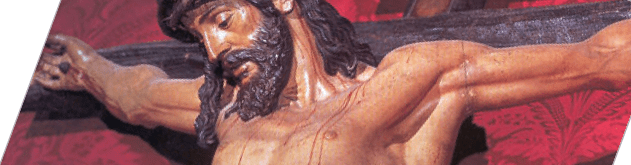
M was a student from Messiah, a Mennonite. She wrote this poem about the crucifix that hung in the convent library where we had class. Here it is.

To the Crucifix

Jesus Christ I must confess
I’m staring at your chest again,
Your naked hairless body hung
Here on this wall again
Good God and don’t you know it’s
Got to be indecent.

High Christ I’ve cried so long for this pierced
Passion but popping up here
Now and again and forever
For Christ’s stake
An indecent eternity you bleed
One has only so much hair to
Bathe your feet in.

Christ I wonder if to relieve you
One took out one solid nail
That held your hand,
If your right arm dropped
Heavy across down the face
Of the sad glass clock
That fixes you,
The minute hand towards the
Half hour
Swung a circle that would
Move you once
So we could look away.


crucifix for blog 3


K went to Houghton College. Most afternoons at 5:00 she walked to a service at a convent where the nuns are cloistered and silent but for the singing and prayers of their services. Once she took me. She said the Amens right with the sisters, and afterward they smiled audibly at her through the bars in the chapel. She told me those services might be saving her faith.

W was a Gordon guy, and he was constantly arriving home noisy and happy after some dinner or service or concert with his friends the Lardanis and the other charismatic Catholics—people who were so salty, so irrepressibly incandescent that the new Bishop of the entire region invited them to hold services in his private chambers.

And a couple days before that semester ended, something took me to W’s room. He was in there among a heap of clothes and books and scraps of poems, crying fat tears. And he didn’t kick me out, and I said something like what you’d try to say then, and after a while he said, “In my life I’ve never felt such belonging.”

In his life.

M’s poem is one that I’m glad got written. It’s honest and surprising and maybe a little worrisome. Honest like the woman at the well: “That chump’s not my husband.” Surprising like the woman who said, “Yeah, but even the dogs get to eat the scraps that fall from the table.” M’s poem reminds me that God loves problem children like Jacob and David.

—and like M, K and W, who were learning a new faith language in Orvieto. Or maybe adding new words and sentences and silences to the language they already speak. How do you get to the place where you fall in Love—where the Amens are finally true and truly meant? For them it was by pulling up stakes again and wandering, not commuting like Americans, but wandering like foreigners—

into white rooms pinned with crucifixes,
into chapels of communicative nuns,
or into homes where, though you hardly speak Italian, the table is laid, and you’re made to understand: Mangia. Eat. Mangia!

Mangia.

-Delivered some years back in a Global Education convocation.

Essaying – on Learning from Corrie ten Boom

For symposium this year, my public story class put together a podcast on appearance & reality. (Some of you came and told stories.) We all wrote essays about moments in our lives that touched the theme at different angles.

I got thinking about how sometimes pretending or acting As If can be a way toward truth, a way into feeling it.

Sometimes you don’t feel like praying, or saying thanks, but you do those things anyway and end up feeling grateful. Sometimes you don’t feel like loving your spouse, but you do—and then you do. Sometimes you really don’t want to love your enemy, or pray for them, but when you bring them before the throne they become a person, not just a name–historied and complex as you are, with things you can try to forgive, the way you hope to forgive yourself.

Besides Peter jumping out of the boat acting as if he could walk on water, the best story of this kind that I know is Corrie Ten Boom’s.

She’d been a prisoner in Ravensbruck concentration camp. After the war she traveled the world speaking about God’s forgiveness. At one such event a man approached her whom she recognized as having been one of the cruelest guards in Ravensbruck.

He told her he’d become a Christian—and then he put out his hand and asked her to forgive him for the things he’d done as a guard.

She couldn’t do it. Here’s what she writes:

‘Help, Lord!’ I prayed silently. ‘I’ll lift my hand. I can do that much. You supply the feeling.’

And so woodenly, mechanically, I thrust my hand into the one stretched out to me. And as I did, an incredible thing took place. The current started in my shoulder, raced down my arm, sprang into our joined hands. And then this healing warmth seemed to flood my whole being, bringing tears to my eyes.

‘I forgive you, brother!’ I cried. ‘With all my heart!’


Here are three of your colleagues, Nate Youndt, Sarah Henkels and Katherine Allison, to read excerpts from their essays—to tell stories from their lives. In Nate’s, he tries something similar to what I’ve been saying, but ends up with more truth than he’s ready for. In Sarah’s, a cousin’s reality is almost too hard for a family to bear. And for Katherine, one chance encounter changes the whole kingdom forever after.

All these stories bear out what we know, which is that truth is better than semblance, even if it’s hard, and hard to get to.